Not every festival needs to be approached through spectacle. At Tống Trân, a more rewarding starting point is the relationship between learning, family support and the stories a community passes on. Think of the visit as a conversation across generations rather than a stop made only to ask for examination luck. What does it mean to honour a scholar? Who makes study possible, and whose contribution gets remembered? Those questions give both adults and younger travellers something to carry through the temple visit. They also keep the day connected to ordinary life, where perseverance and care matter long after any ceremonial gathering is over.
History & story
Tống Trân is honoured locally as a gifted scholar, and the story of Tống Trân and Cúc Hoa provides an important cultural lens for the visit. Treat the narrative's episodes and honorary descriptions as part of literary and local devotional memory unless supported by separate historical evidence. You do not need to settle every biographical question to understand why the story matters. Ask which qualities the community wants younger generations to remember. The answer may reveal more about the festival's present meaning than a list of miraculous accomplishments. A careful visitor can respect the tradition while keeping different kinds of evidence distinct.
A literary and devotional memory
Tống Trân is honoured locally as a gifted scholar, and the story of Tống Trân and Cúc Hoa provides an important cultural lens for the visit. Treat the narrative's episodes and honorary descriptions as part of literary and local devotional memory unless supported by separate historical evidence. You do not need to settle every biographical question to understand why the story matters. Ask which qualities the community wants younger generations to remember. The answer may reveal more about the festival's present meaning than a list of miraculous accomplishments. A careful visitor can respect the tradition while keeping different kinds of evidence distinct.
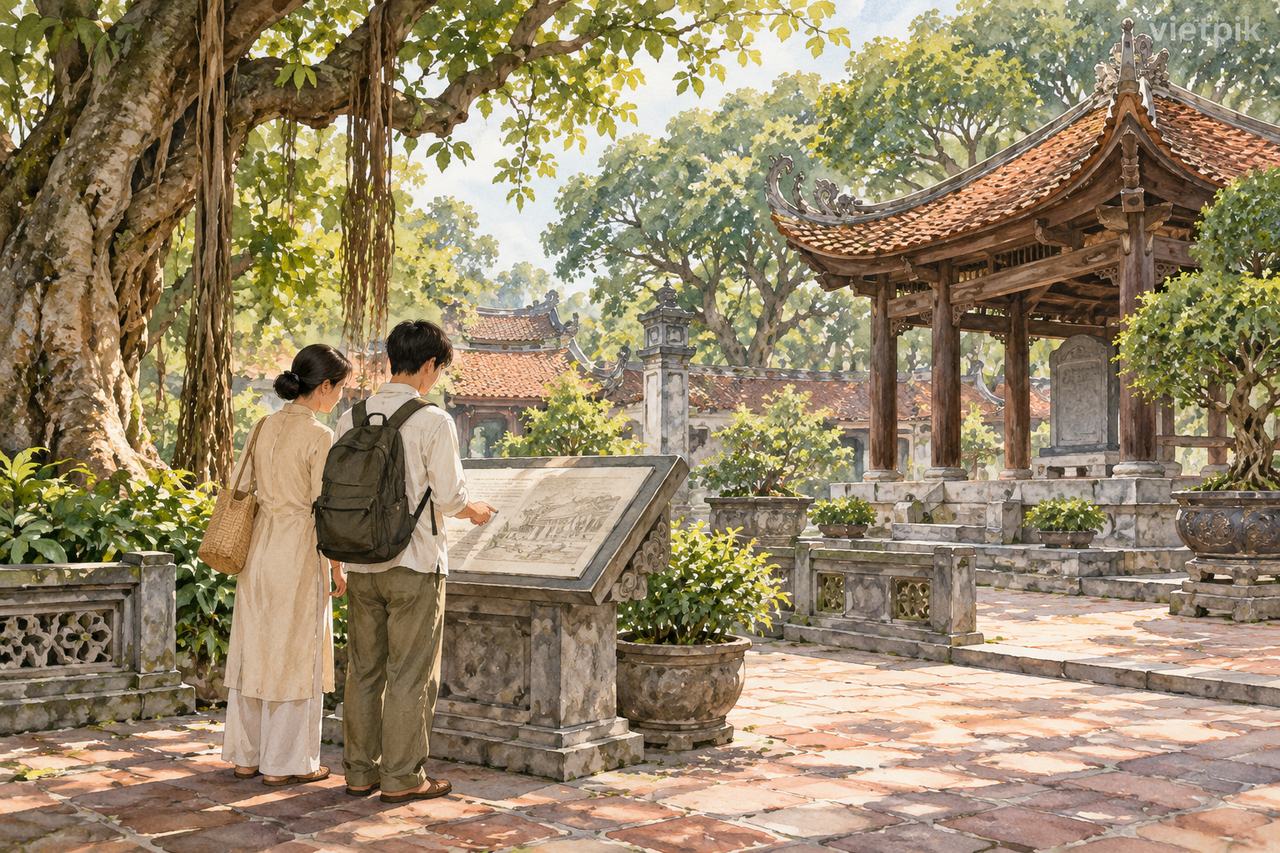
Do not let Cúc Hoa disappear from the story
The companion story of Cúc Hoa directs attention to care, loyalty and the support behind a scholar's progress. Read it with curiosity, including questions about how its social expectations differ from those of today. A cultural visit does not require you to endorse every value in an old tale unchanged. It can instead create space to discuss what deserves admiration and what deserves rethinking. If a guide explains links between the two places of worship, ask how those connections are expressed during the announced festival. Avoid assuming that a procession described in an older account will necessarily take place on your chosen date.
The provisional 2027 dates
The customary interval used here is the tenth to fifteenth days of the fourth Vietnamese lunar month, also reflected in the local 2026 preparations. In 2027 that corresponds to 15–20 May. This is a planning projection, not an official programme or a promise of daily performances. Check which dates include public activities and which are principally devoted to worship. For a day trip, choosing the right activity matters more than arriving somewhere inside a six-day range. Ask about the venue and any access arrangements at the same time. Keep non-refundable transport or accommodation decisions separate until the relevant details are confirmed.
Make it a family visit with a real discussion
Before arriving, invite each person to bring one question about learning. Younger travellers might ask how books were used, while adults might ask how a village celebrated achievement. At the site, find a quiet moment to compare answers rather than questioning a child in front of a crowd. Do not promise that a ritual will produce better grades. The more useful connection is between aspiration and everyday habits: reading, practice, rest and support. A small notebook can be enough for the day. Let everyone record something in their own words, including a drawing or a question they did not feel ready to ask aloud.
Plan for a warm-season outing
A May outing calls for a practical check of the weather forecast shortly before departure. Do not build an entire day around standing in an exposed courtyard. Arrange drinking water, a place to rest and a flexible lunch break, particularly for children or older companions. Verify the current route and entrance with a local contact instead of relying solely on an old district name. When adding another site connected with the story, check that it is open and that the extra journey suits the group. A carefully paced pair of stops can work well; several rushed visits rarely leave enough room for conversation.
Keep offerings and expenses proportionate
Ask about vehicle waiting charges, parking and meals before committing, since this article has no verified 2027 price schedule. If you choose to make an offering, follow the site's guidance and keep it modest enough to manage comfortably. Learning is the theme of the visit, not a reason to accept pressure to buy a particular object. For a meaningful keepsake, consider recording the title of a story or a useful reading recommendation supplied by a guide. If buying food or a craft, check its origin and practical use. A purchase should serve your interest rather than substitute for the time spent understanding the place.
Let the visit continue at home
Choose a short passage of the Tống Trân–Cúc Hoa story to read afterwards, then compare it with the account you heard locally. Differences can make an interesting conversation rather than a problem to erase. Note whether a statement came from a literary text, a guide or your own interpretation. The AI images here evoke a learning-themed temple visit and writing materials; they do not reproduce the actual site's monuments or authenticated scholarly relics. What lasts should be the questions you discussed together. A festival visit about study becomes particularly meaningful when it leads to another small act of reading, attention or mutual encouragement.
Original Vietpik editorial. Food photographs illustrate dishes and do not represent a specific restaurant unless stated.
tongtran.hungyen.gov.vn dulich.hungyen.gov.vn baonghean.vn lichvannien.com.vn Last updated: 2026-09-28