A place of remembrance becomes easier to understand when history is given both a date and a human scale. Xương Giang offers that opportunity through a festival shaped around the memory of a decisive campaign and renewed by people gathering in the present. Flags and processions may catch the eye first, but the deeper interest lies in how a community chooses to remember. Visit with a short historical outline, then let the local interpretation and the movement of the festival add detail. The result can be a much richer day than photographing a monument and moving on without knowing why it stands there.
History & story
The festival commemorates the Chi Lăng–Xương Giang victory of 1427, associated with the Lam Sơn struggle against Ming rule. Local reporting places the Xương Giang victory site at the centre of the commemoration and records its recognition as a special national historical site in 2019. That historical context should be kept distinct from the modern design of any ceremony or stage performance. Today's celebration interprets and remembers the past; it is not an unchanged surviving spectacle from the fifteenth century. This distinction helps visitors appreciate both the historical subject and the contemporary work of remembrance.
The historical starting point
The festival commemorates the Chi Lăng–Xương Giang victory of 1427, associated with the Lam Sơn struggle against Ming rule. Local reporting places the Xương Giang victory site at the centre of the commemoration and records its recognition as a special national historical site in 2019. That historical context should be kept distinct from the modern design of any ceremony or stage performance. Today's celebration interprets and remembers the past; it is not an unchanged surviving spectacle from the fifteenth century. This distinction helps visitors appreciate both the historical subject and the contemporary work of remembrance.
Why the processions matter
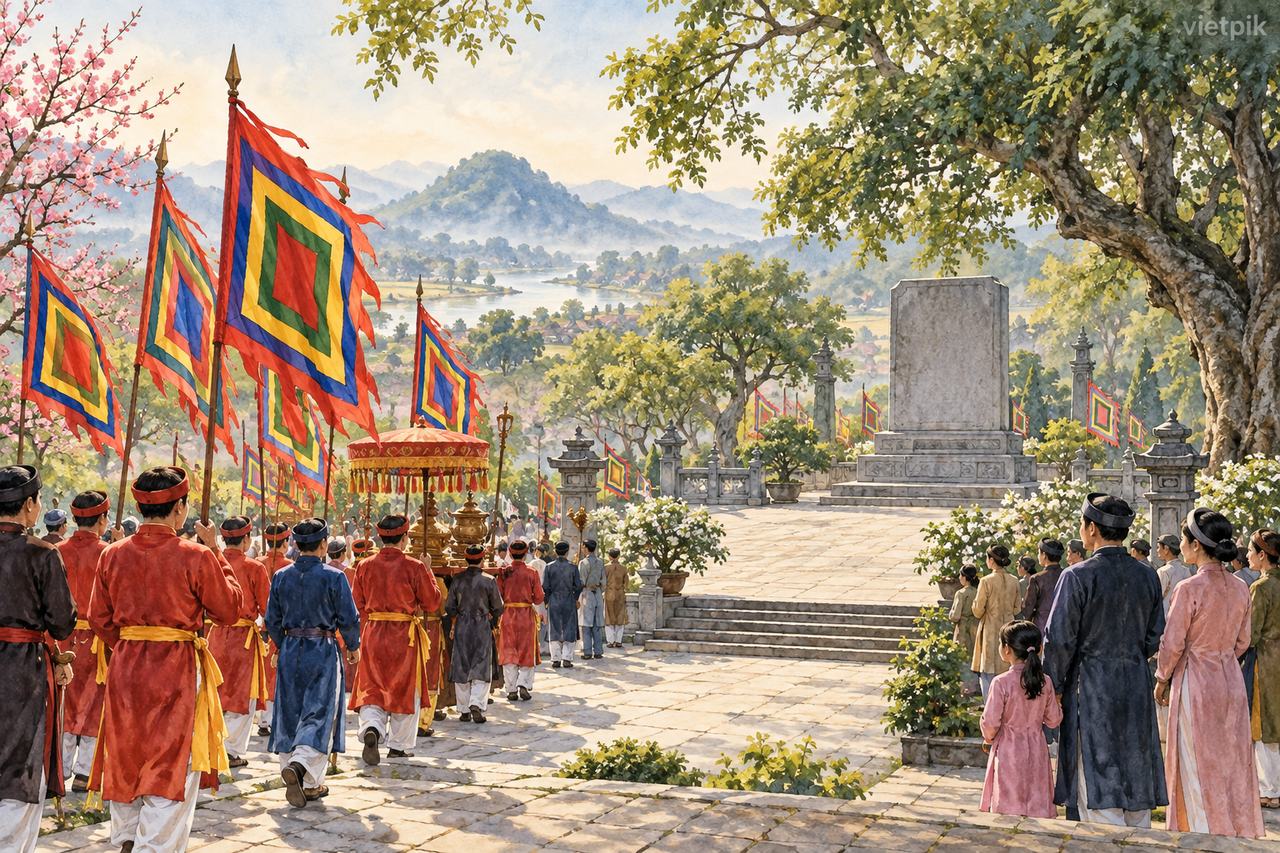
The regional tourism account describes delegations moving from local places of worship towards the festival centre on the sixth day of the first lunar month. Rather than seeing them simply as decoration, consider how they bring different neighbourhoods into one public act of remembrance. The 2026 programme spread activities across several days, showing how the central observance can sit inside a broader event. Routes, participants and performances may change. The enduring point is the collective act, while the details you will actually see must come from the programme for your year of travel.
2027: a milestone, not a promised anniversary show
The customary sixth day of the first Vietnamese lunar month corresponds to 11 February 2027. The year is also 600 years after 1427, but that arithmetic does not establish a special anniversary programme. No official 2027 schedule is confirmed in this article. The opening night or surrounding activities may fall outside the main-day milestone, as previous editions demonstrate. Keep 11 February as a tentative reference, then check the organiser's announcement for the ceremony you want to attend. Do not assume fireworks, a large show or a fixed multi-day duration simply because the anniversary is round.
Prepare a history visit that is easy to follow
Before setting out, note three anchors: the Lam Sơn movement, the year 1427 and the relationship between a victory site and its later commemoration. At the site, use interpretation panels or a knowledgeable guide to connect those anchors. If a performance retells the past, enjoy it as interpretation and ask afterwards which elements are documented and which are theatrical choices. That question need not spoil the experience. It can make the difference between remembering a dramatic image and gaining a usable understanding of the history behind it.
Keep the festival at the centre of the route
For a first visit, combine the confirmed festival activity with time to explore the memorial site and a proper meal break. An additional cultural stop should fit around those priorities, not force a rushed departure. The site is now in Bắc Ninh province; older material uses Bắc Giang, which remains useful as a historical location label. Save the exact meeting point and current directions rather than searching only by a former provincial name. When arranging transport, describe the specific Xương Giang site you intend to visit so that similarly named commemorations are not confused.
A clear budget and a manageable group
Include transport, meals, drinks and any interpretation service in your estimate. Ask whether the driver can wait through an extended ceremony and agree on an alternative pickup point if roads near the site are restricted. For a group, choose one person to keep booking details and another clear meeting point for anyone who leaves the crowd. This article does not invent admission fees or guarantee free services. Confirm prices through the actual provider. A small amount of practical coordination gives everyone more freedom to concentrate on the ceremony rather than repeatedly checking where the others have gone.
Tell the story with the right scale
When writing about the visit, separate the fifteenth-century event, the history of the memorial place and the festival edition you attended. Avoid presenting a modern ceremonial object as a battlefield relic unless its provenance is established. Credit an explanation given by a guide with permission, and label any staged scene accurately. Such care does not make a travel account dry. It gives the reader something more lasting than exaggerated grandeur: a clear sense of why people gather here, what they remember together and how the place continues to matter in the present.
Original Vietpik editorial. Food photographs illustrate dishes and do not represent a specific restaurant unless stated.
bacgiang.bacninh.gov.vn dulichbacgiang.gov.vn dulichbacgiang.gov.vn baonghean.vn Last updated: 2026-09-28