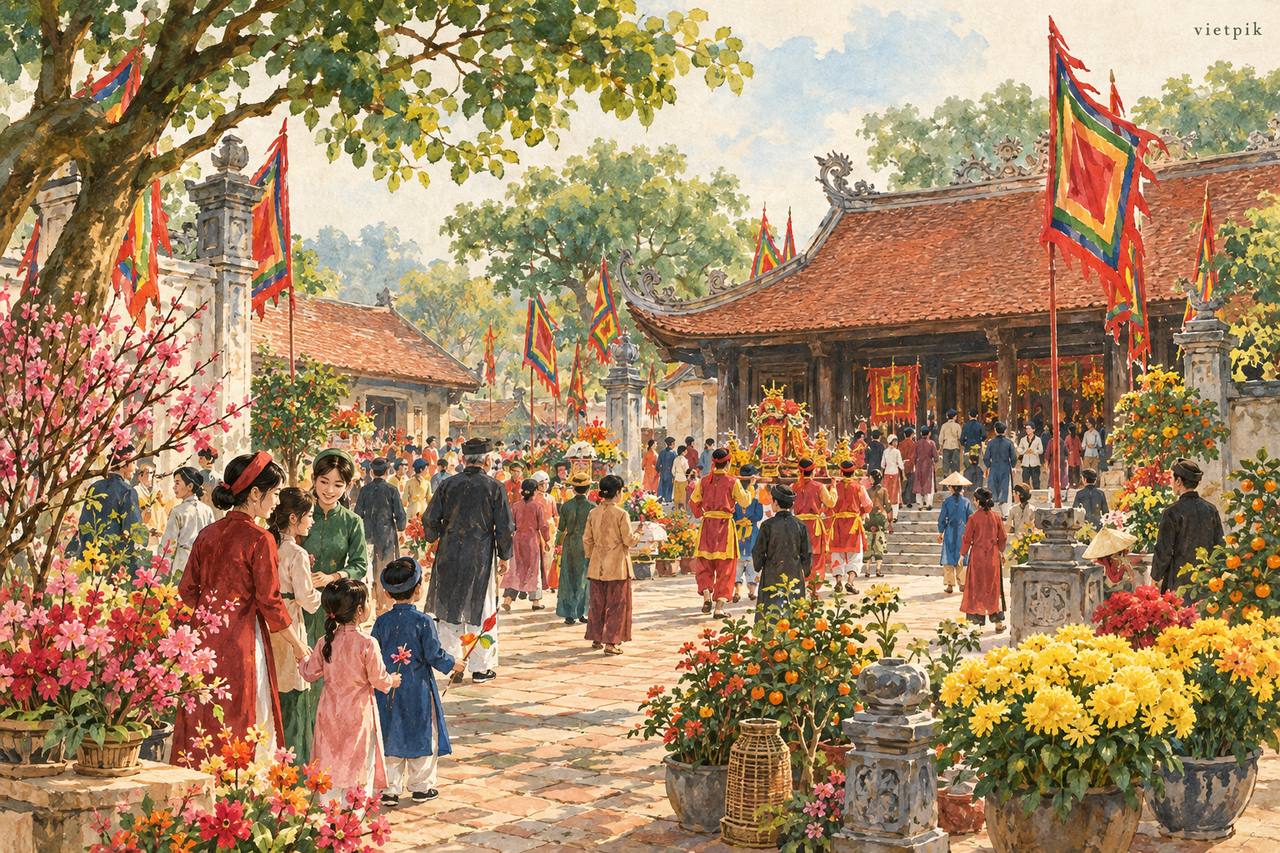
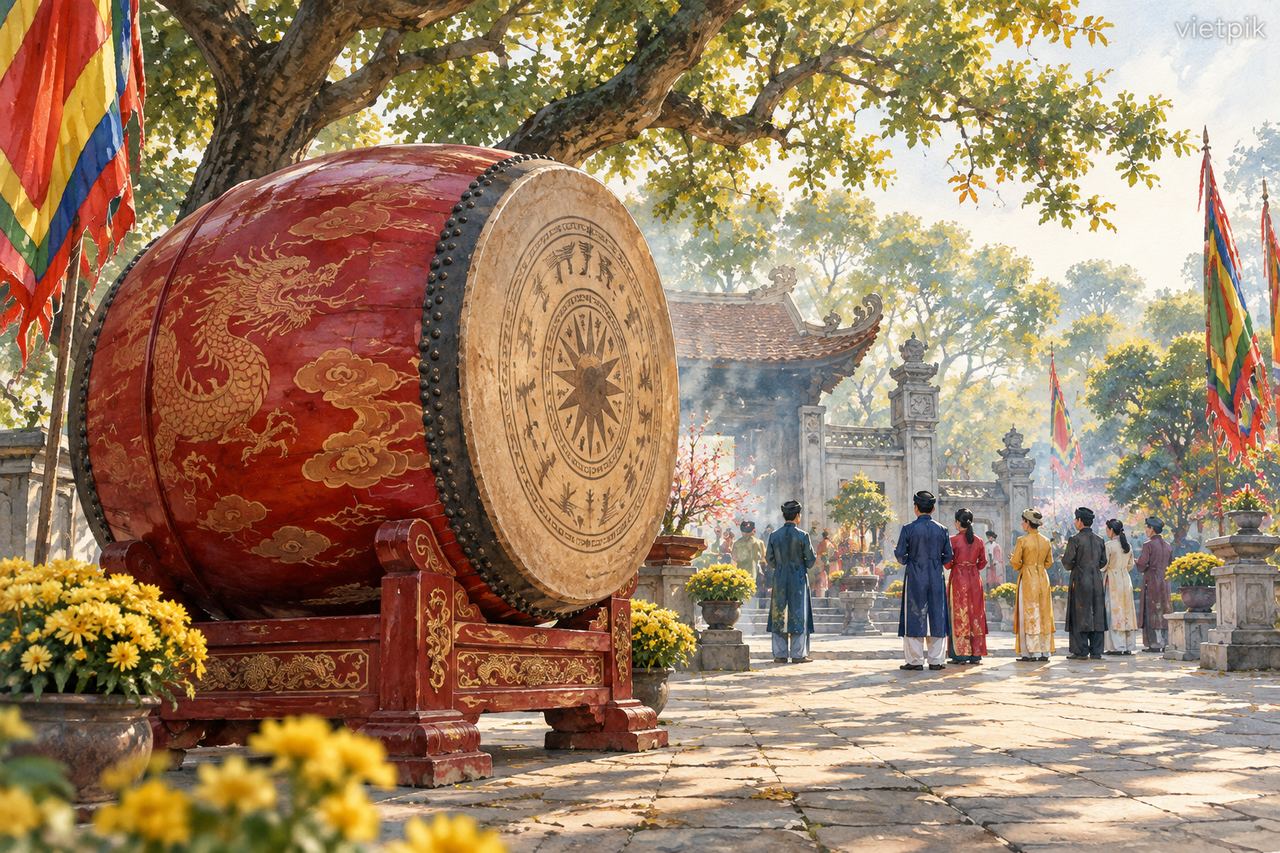
Bối Khê Pagoda Festival offers a clear lesson in scale: a local sacred centre can hold relationships extending across many villages. In the 2026 edition, the inter-community procession brought fourteen participating communities associated with three historic tổng to the pagoda. That fact is more informative than a vague statement about a “large crowd,” because it points to organisation, reciprocity and remembered regional ties. Bối Khê is Đại Bi tự at Tam Hưng and is not the Trăm Gian Pagoda festival already covered by Vietpik. This article keeps the annual lunar frame distinct from the dated 2026 programme and does not promise an identical 2027 procession.
History & story
The pagoda combines Buddhist worship with veneration of Đức Thánh Bối, Nguyễn Bình An, in a “Buddha before, Saint behind” arrangement. This layered plan helps explain why one label cannot describe every space. Rather than treating Buddhist and saint worship as a contradiction, approach them as different relationships organised within one compound. The sequence of spaces helps make that coexistence visible. For a first visit, establish which building serves which function before following a crowd through it. The name Đức Thánh Bối is also a reminder to keep local usage intact. Connections with Nguyễn Bình An at other sites do not make those sites interchangeable with Bối Khê or turn their festivals into one event.
Buddha and Đức Thánh Bối
The pagoda combines Buddhist worship with veneration of Đức Thánh Bối, Nguyễn Bình An, in a “Buddha before, Saint behind” arrangement. This layered plan helps explain why one label cannot describe every space. Rather than treating Buddhist and saint worship as a contradiction, approach them as different relationships organised within one compound. The sequence of spaces helps make that coexistence visible. For a first visit, establish which building serves which function before following a crowd through it. The name Đức Thánh Bối is also a reminder to keep local usage intact. Connections with Nguyễn Bình An at other sites do not make those sites interchangeable with Bối Khê or turn their festivals into one event.
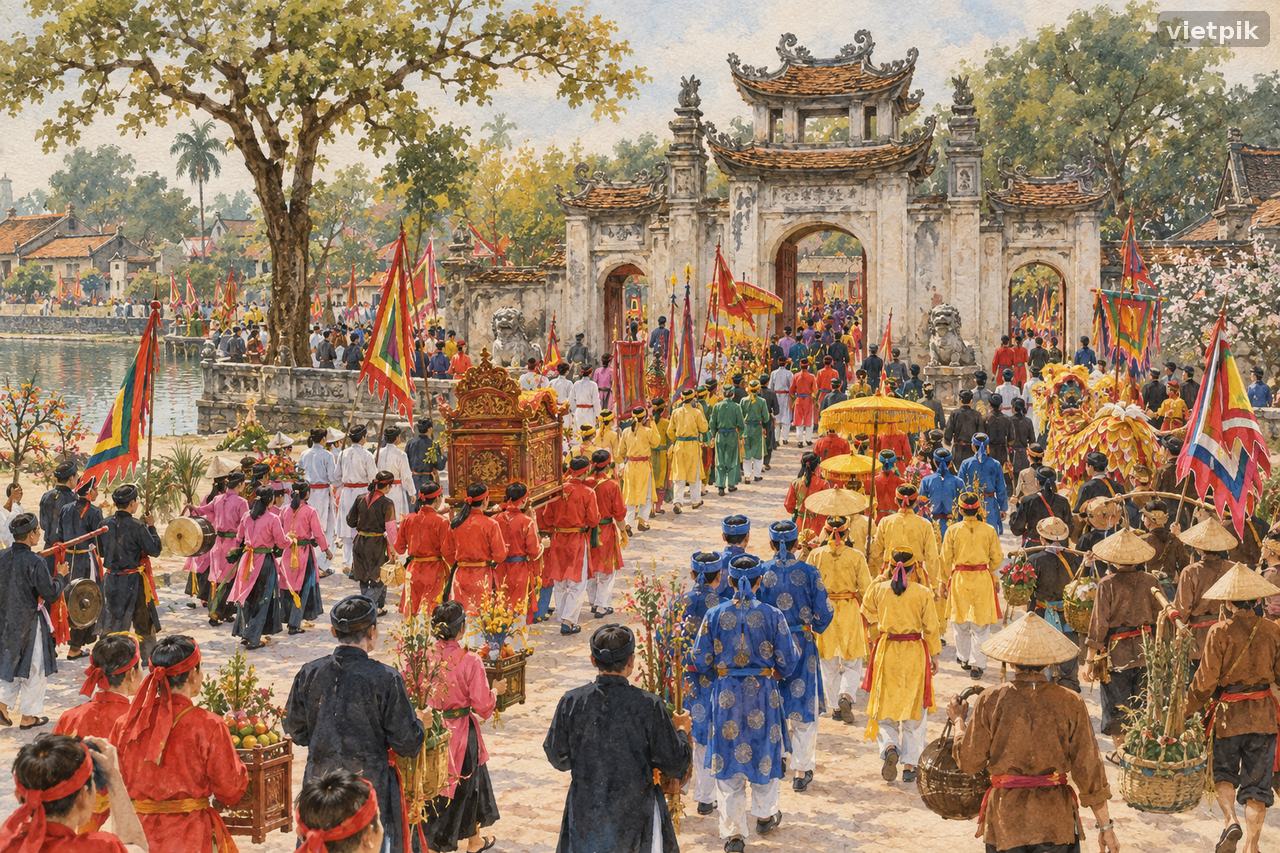
Fourteen villages meeting in 2026
The 2026 procession assembled fourteen villages linked to Bối Khê, Đại Định and Bình Đà historic groupings. Each delegation prepared its own ceremonial presence before converging at the site. The fourteen-village gathering reported in 2026 makes scale meaningful through relationships, not merely through a large headcount. Delegations travel toward a common sacred centre while retaining their own identities. A good viewing position can show this joining process: one group waits, another arrives, and the shared courtyard becomes a meeting place. Read the delegation's displayed name when available instead of identifying it from colour alone. Similar flags or clothing are not enough to assign a village or ceremonial responsibility.
Opening day and procession day
Official reports place the 2026 festival on lunar days ten to twelve of the first month. The eleventh marked the opening, while the twelfth carried the major inter-community procession. The 2026 span corresponded to 26–28 February, with the opening on 27 February and the inter-community procession on 28 February. A visitor wanting to see the latter would need the activity date, not simply the first festival day. The same distinction must be checked afresh for any future edition. Keep the lunar reference as cultural context while leaving the Gregorian dates for 2027 unfilled. A sequence documented once offers insight into organisation, not a guarantee of identical arrangements.
Architecture that shapes movement
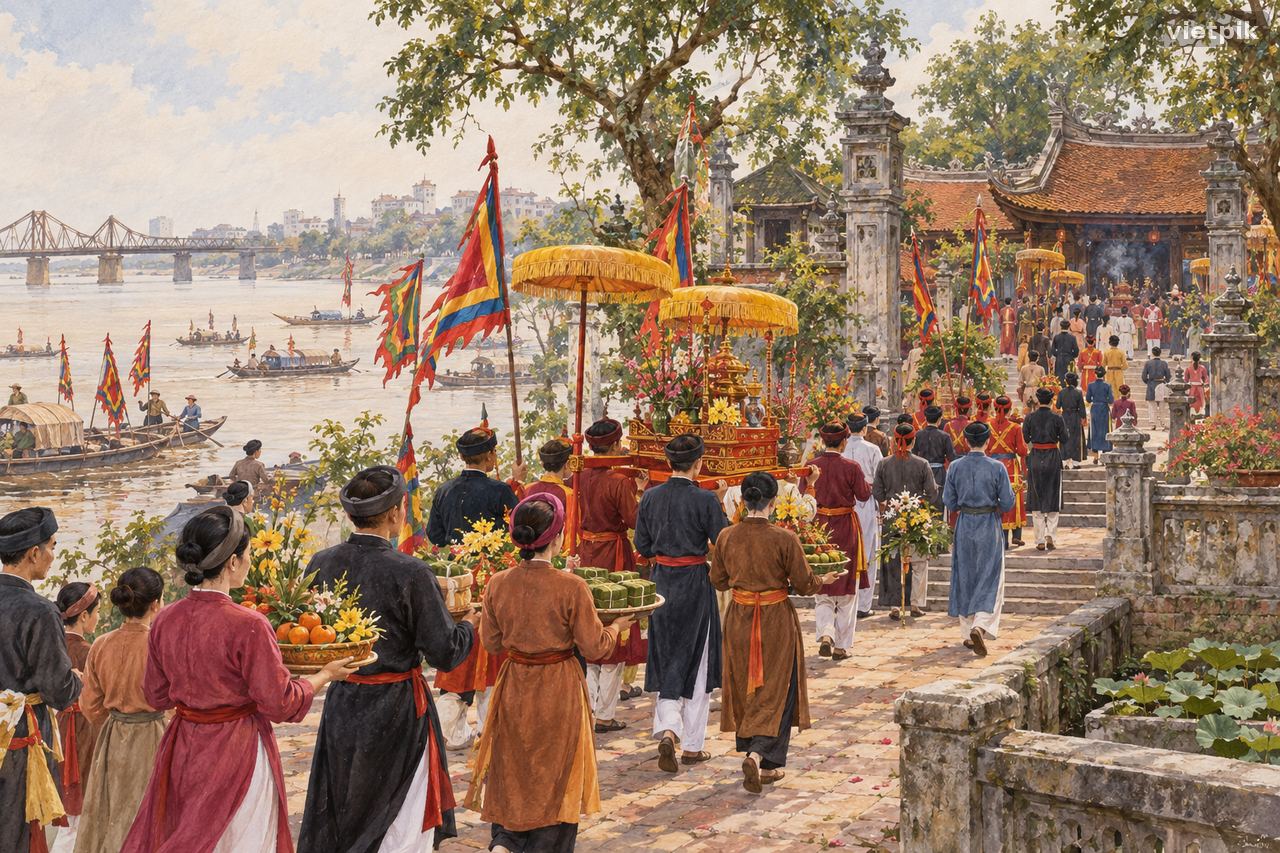
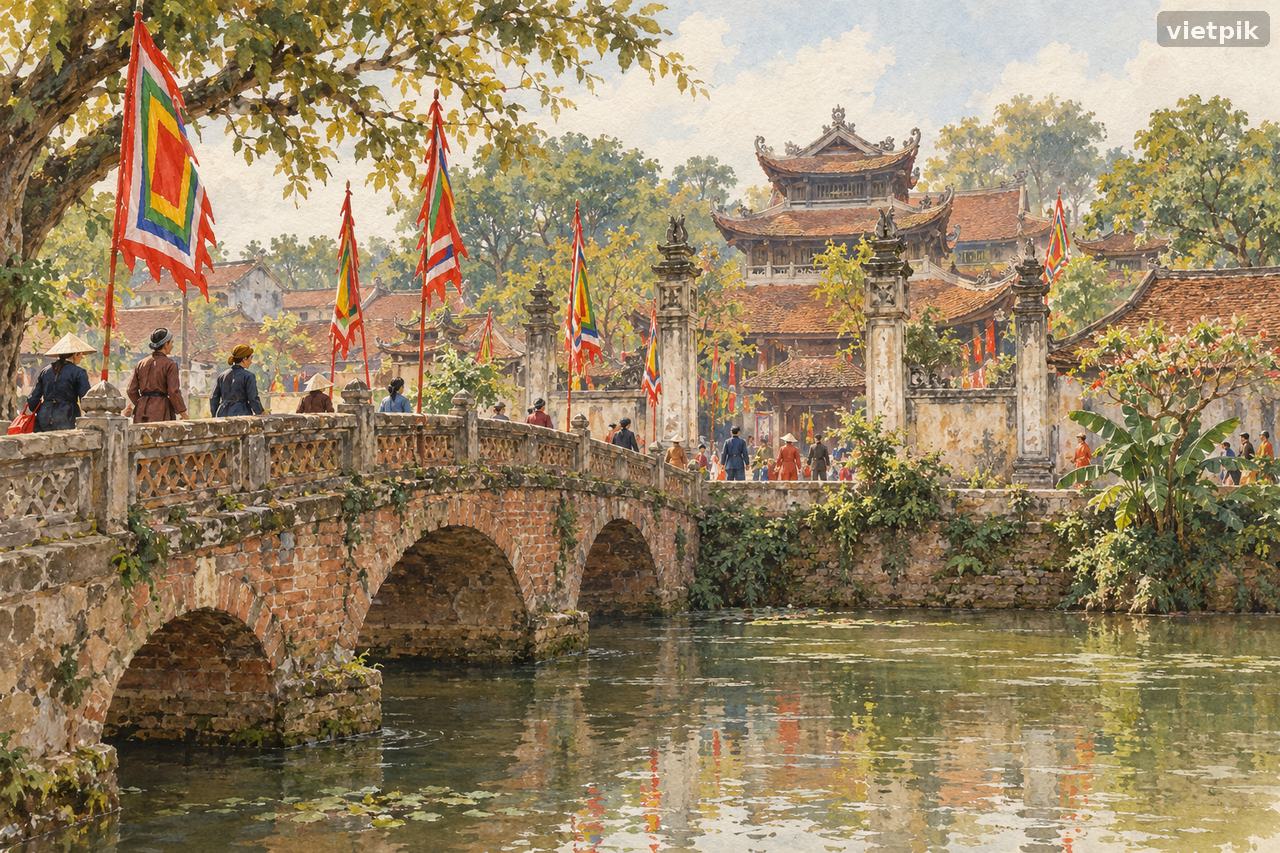
Architecture such as the bridge, gates and successive worship halls shapes how processions compress and expand. Visitors should watch from edges identified by organisers. A narrow passage and an open courtyard ask different things of a procession. At a constriction, people need room to align and turn; in a larger space, the arrangement can become visible as a whole. This provides an accessible way to appreciate architecture without guessing its symbolism. Watch how the built setting supports or limits movement, but stay out of the passage itself. A camera held beyond a barrier can obstruct a bearer even when the photographer's feet remain outside it.
Three purposes for a family visit
A complete visit does not require entering every building during peak ceremony. Prioritise the public route, heritage display and one quiet architectural view after the crowd thins. For a family group, divide the purpose of the visit into worship, viewing the shared procession and looking at the buildings. Trying to do all three simultaneously can produce unnecessary crowding and frustration. Someone accompanying an older relative may prefer a shorter public segment and leave detailed architectural looking for a quieter time. No particular seating or assisted access is guaranteed here; contact the site or organisers if that provision is essential before committing to the busiest part of the programme.
Understanding hàng Tổng
Because multiple communities are represented, avoid ranking costumes or delegations as more authentic from appearance alone. Names and roles should come from the programme or local explanation. The term hàng Tổng carries a relationship to older territorial organisation. It should not be presented as if it were a list of current administrative units. When asking about a delegation, distinguish the historical grouping, the village name and today's address. This is especially helpful for visitors tracing family connections or comparing older photographs. It keeps a festival's inherited geography understandable without making the mistaken claim that historical boundaries continue unchanged on a modern government map.
A meeting of communities
Record the distinction between an annual festival and special features of the 2026 edition. That protects future readers from treating fourteen-delegation details as a guaranteed yearly timetable. What distinguishes Bối Khê in this article is the joining of multiple communities around a compound with more than one devotional layer. A useful concluding image might therefore show the approach of a delegation or the transition between shared courtyard and worship space. Avoid presenting an editorial illustrations of such a scene as evidence for the exact 2026 arrangement. The illustration introduces an idea; the named programme and local record establish what actually took place and whose participation was documented.