Chèo Tàu of Tổng Gối is a ceremonial singing tradition built around an arresting stage image: boats and wooden elephants moving symbolically on dry land while women’s voices carry inherited repertory. The form is tied to commemoration of Văn Dĩ Thành and to communities of the former Tân Hội area, now tracked under Ô Diên in current local reporting. Unlike an annual attraction, major festival presentation has been described on a multi-year cycle. The 2024 edition and the five-year rhythm are therefore evidence about recent practice, not proof that a full event will occur in 2027.
History & story
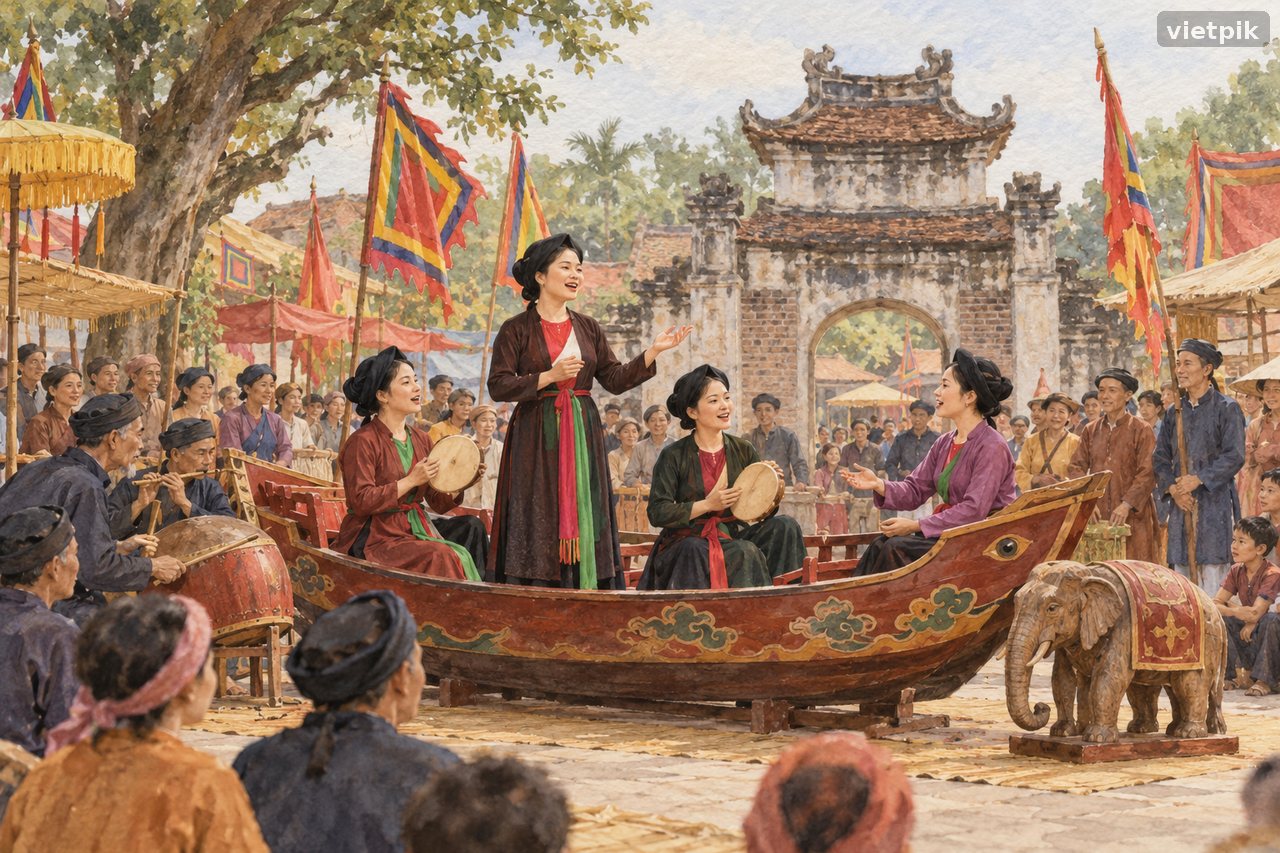
The performance honours Văn Dĩ Thành in local tradition and joins worship with a specialised vocal form. Historical claims about his life should be separated from the community’s devotional narrative. The dry-land boat is the first clue to reading the form. It is an object around which movement and voice make a ceremonial world, not a vessel waiting to be launched. The wooden elephant belongs to that same performed space. This helps newcomers avoid reducing the tradition to a boat race or assuming that the word chèo identifies an ordinary theatre programme. Begin with how the local performers name their art, then let the roles and exchanges explain its distinctive structure.
A boat that performs on land
The performance honours Văn Dĩ Thành in local tradition and joins worship with a specialised vocal form. Historical claims about his life should be separated from the community’s devotional narrative. The dry-land boat is the first clue to reading the form. It is an object around which movement and voice make a ceremonial world, not a vessel waiting to be launched. The wooden elephant belongs to that same performed space. This helps newcomers avoid reducing the tradition to a boat race or assuming that the word chèo identifies an ordinary theatre programme. Begin with how the local performers name their art, then let the roles and exchanges explain its distinctive structure.
Voices, roles and stage objects
Sources describe roles such as chúa tàu, cái tàu, con tàu and quản tượng, with dry-land boat and elephant props. The repertory includes several named forms rather than one generic chèo song. The boat and elephant roles create relationships that listeners can follow even without understanding every lyric. Watch who begins a phrase, who responds and how bodies orient toward one another. The stage objects are meaningful because people animate them through coordinated song and movement. A photograph of an empty boat may show craft, but it cannot convey the full performance. For that reason, allow listening time before choosing images, and resist asking singers to freeze a passage into a convenient pose.
Recognition is not a festival timetable
Recent cultural reporting gives a five-year festival rhythm and lunar days around thirteen to fifteen of the first month. A separate report confirms the 2024 event on days fourteen and fifteen. There is also a distinction between heritage recognition and festival scheduling. The official decision is dated 14 May 2025, and the public ceremony announcing recognition was reported in 2026. Neither date becomes the regular festival anniversary by itself. Likewise, a teaching session can sustain the tradition between major gatherings without being a full festival. In planning a 2027 visit, identify whether the advertised activity is a ceremony, a concert excerpt, a class or a major community celebration.
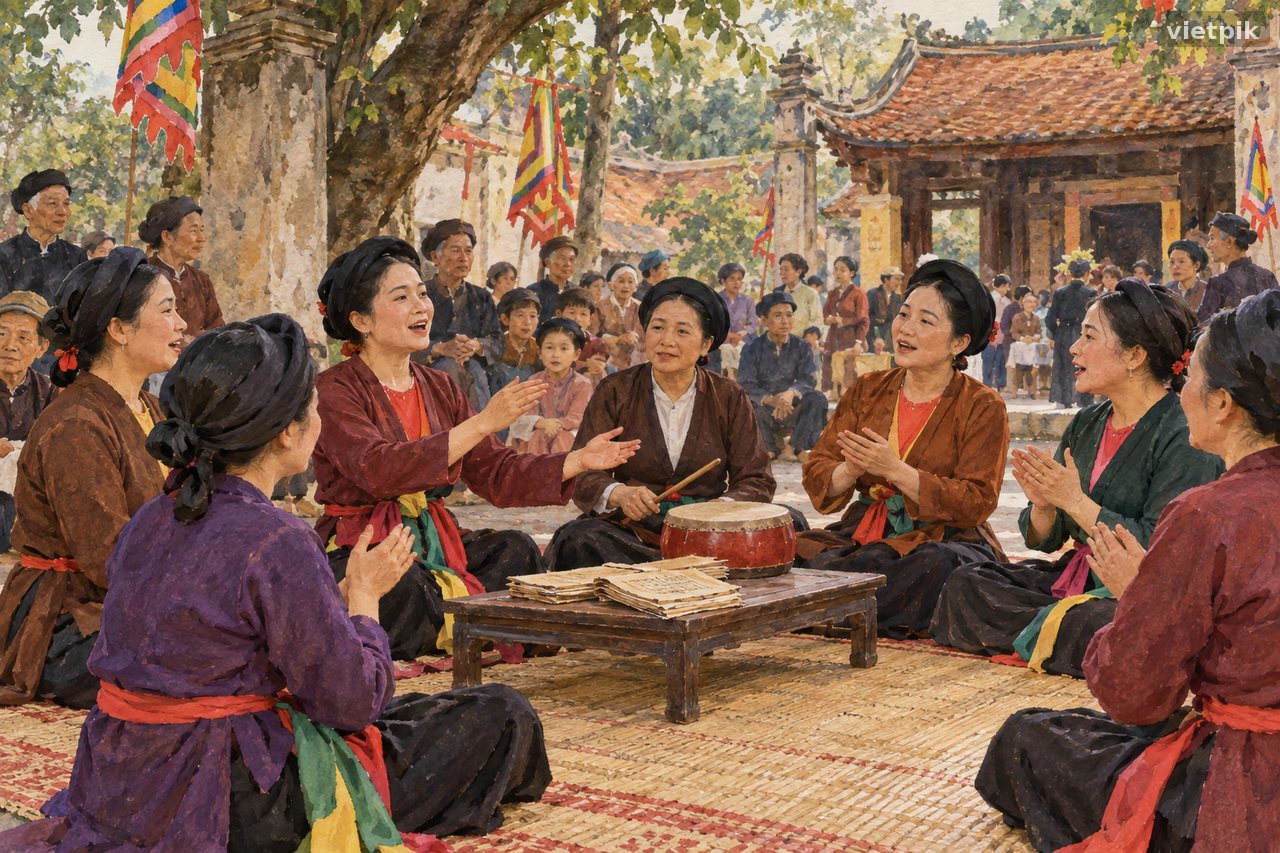
Following a sung exchange
Listen before photographing. Lead and response, changes of text and the relation between voice and prop reveal structure that a silent image cannot capture. An accessible listening exercise is to follow one exchange from initiation to reply, then notice whether the next passage changes pace or purpose. You do not need to record or translate the whole repertory to appreciate its organisation. If permitted to make a short recording, note the performer's description of that passage afterward. Without that explanation, use a modest label such as a call-and-response excerpt rather than naming a specific song form from guesswork or treating every melody as interchangeable.
Festival, excerpt or learning session
A major performance may require concentrated preparation and may not be available on an ordinary visit. Check the named edition and venue rather than travelling on a projected lunar date alone. Someone visiting primarily for singing should confirm that practitioners will actually perform, not simply that a monument or village is accessible. An ordinary visit can still help locate the community, but it may offer none of the musical experience expected from festival photographs. If an organised learning session is available, ask whether visitors may observe before attending; it is work for learners, not an automatically public show. Keep any practical arrangement distinct from the full festival whose schedule remains unconfirmed.
Women as holders of musical knowledge
The tradition has rules about performers and roles that outsiders should not romanticise or reproduce as costume play. Questions are best directed to recognised practitioners after performance. Women are central to the public image of Chèo Tàu, but that should lead to curiosity about knowledge and responsibility rather than decorative descriptions of costume. Ask how a singer learns entrances, remembers text or coordinates with a partner. These questions recognise artistic skill without requiring personal details. If children or students are rehearsing, let the teacher decide whether observation and recording are appropriate. An unfinished phrase or a correction may be important learning, not something to publish as a mistake.
Transmission between major gatherings
When describing revival, avoid saying the form was unchanged for centuries. Sources document interruption, restoration and active teaching; continuity includes deliberate work and adaptation. The local report on transmission in 2025 describes practitioners teaching schoolchildren named singing forms and practical technique. This is a useful counterpoint to the large ceremonial scene: heritage also survives through repetition at a smaller scale. A travel story can acknowledge both without claiming uninterrupted perfection. The distinction between recovered material, teaching and a public performance gives a more honest account of continuity, and directs attention toward the people doing the patient work that makes a future festival possible.