At Đồng Nhân, the memory of the Trưng Sisters is carried by an urban community whose temple story remains tied to the Red River. The festival is not interchangeable with the spring celebration at Mê Linh or the commemoration at Hát Môn, even though all three honour the same historical figures. This guide treats Đồng Nhân as a distinct place, with its own complex of temple, pagoda and communal house, its own river-facing memory, and a programme that must be checked for the year of travel. The aim is to help a visitor read relationships among site, procession and community rather than collect another generic image of the two sisters.
History & story
The present complex at Hương Viên preserves the Đồng Nhân name after the older riverside temple was moved because of erosion. That movement is central to the place identity, not a minor architectural footnote. Think of Đồng Nhân as a name carried across a changing river landscape. A building can move while a community continues to recognise its sacred centre. This makes the riverside connection more than scenery: it helps explain why a visitor encounters both an urban temple complex and memories of a different setting. Read the present address as the place to visit, while treating the older location as a historical relationship to understand, not a second interchangeable destination.
A name carried from the river
The present complex at Hương Viên preserves the Đồng Nhân name after the older riverside temple was moved because of erosion. That movement is central to the place identity, not a minor architectural footnote. Think of Đồng Nhân as a name carried across a changing river landscape. A building can move while a community continues to recognise its sacred centre. This makes the riverside connection more than scenery: it helps explain why a visitor encounters both an urban temple complex and memories of a different setting. Read the present address as the place to visit, while treating the older location as a historical relationship to understand, not a second interchangeable destination.
Water, temple and linked communities
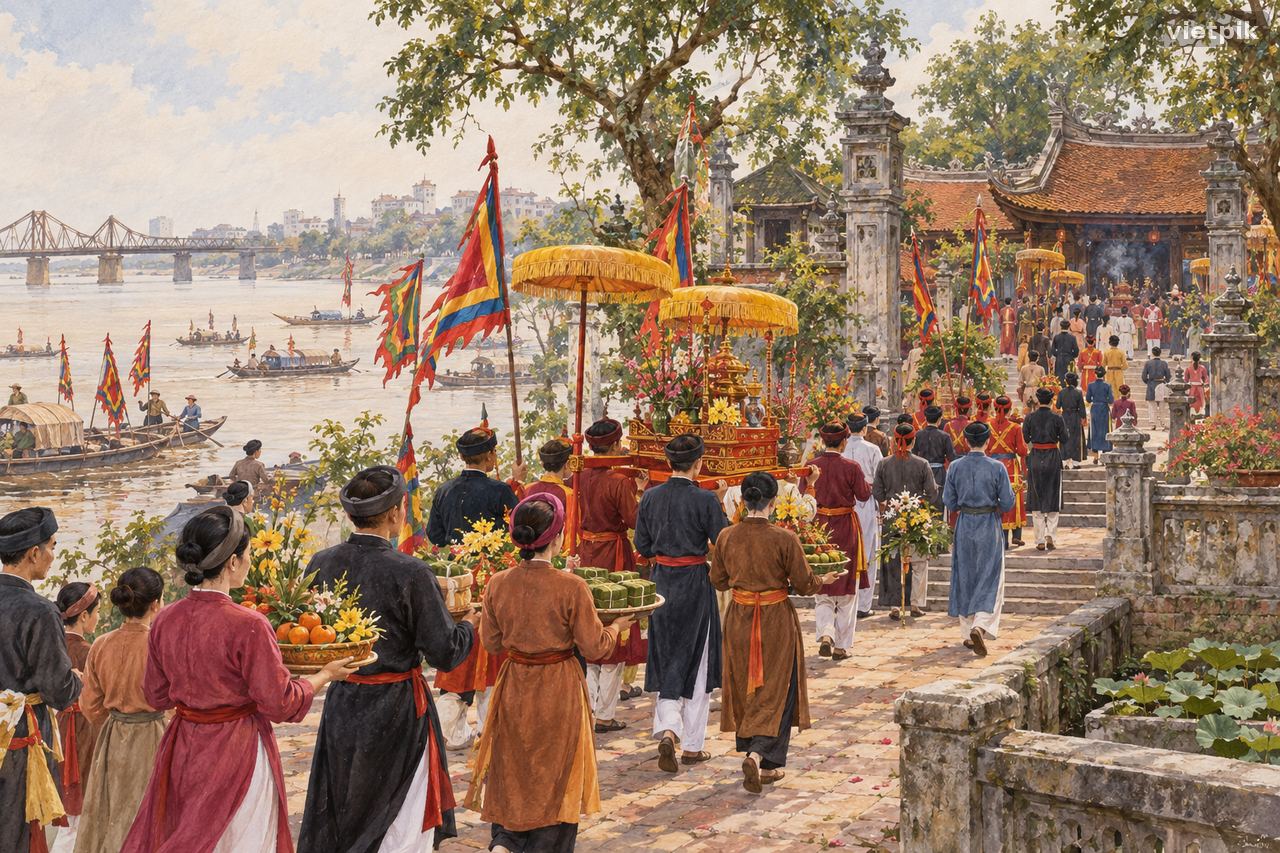
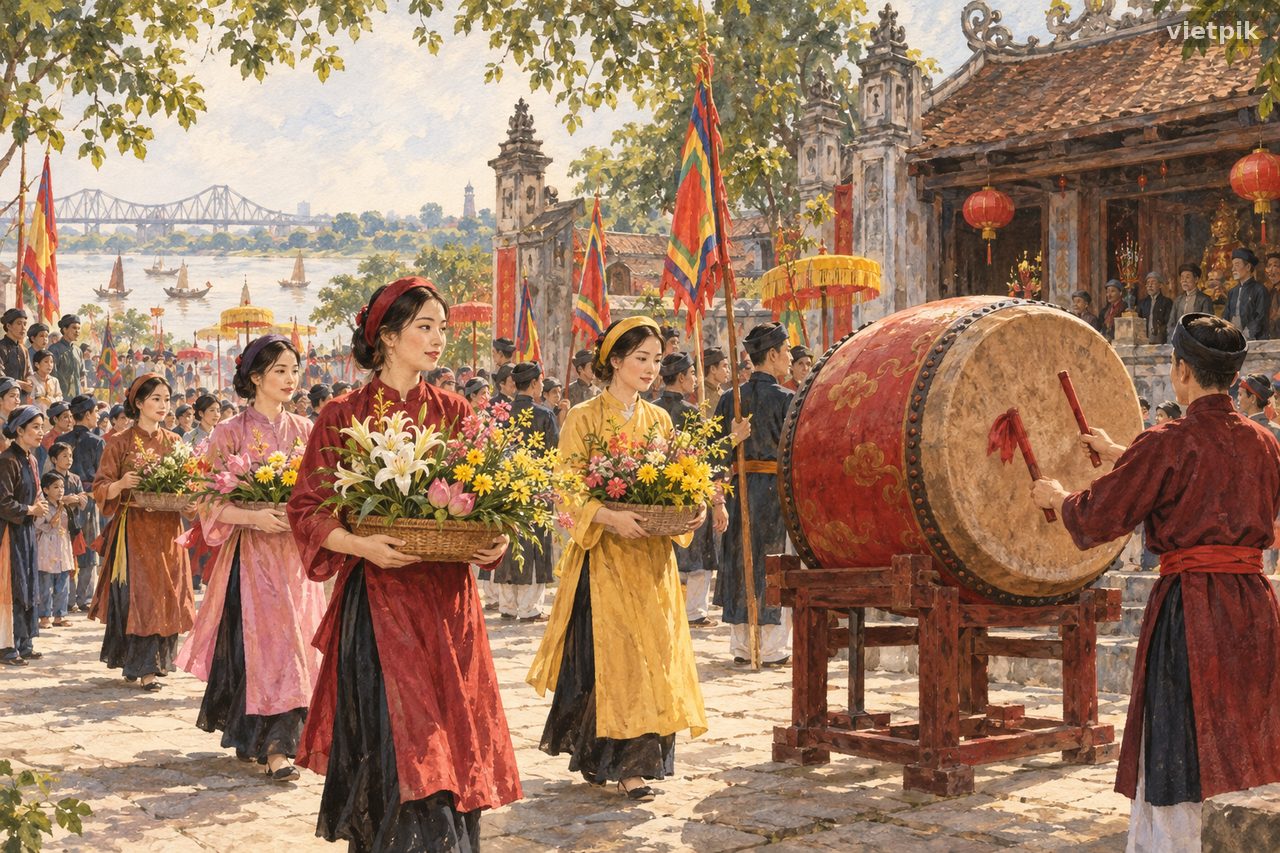
City reporting for 2026 records a water-related observance at the Red River landing and ceremonies at the temple complex. Older descriptions also mention linked communities bringing offerings, so the festival should be read as a network rather than one stage. The local heritage portal describes water brought from the river for the bathing of the statues, and distinguishes the larger water procession as a five-year observance. That distinction matters when looking at photographs: a spectacular boat scene may document a particular edition, whereas temple ceremonies occupy another part of the festival. Ask which stage is public before choosing a viewpoint. Riverbank access and ritual participation are different things; spectators should never infer a boat service from the existence of ceremonial boats.
The main day and the opening ceremony
The sixth day of the second lunar month is the most consistent central milestone. Official 2026 reporting used 23–25 March for lunar days five to seven, while heritage pages vary on the wider traditional span. For planning, keep three notes: the central remembrance day, the span announced for a particular edition, and the activity you hope to observe. The city report records the 2026 opening on 24 March, within the wider three-day period. These are compatible pieces of information, not competing opening dates. A future notice might place public activities around the same commemoration differently. The useful question for 2027 is therefore whether the named ceremony is confirmed, rather than whether a calendar conversion looks plausible.
Reading a compound with three identities
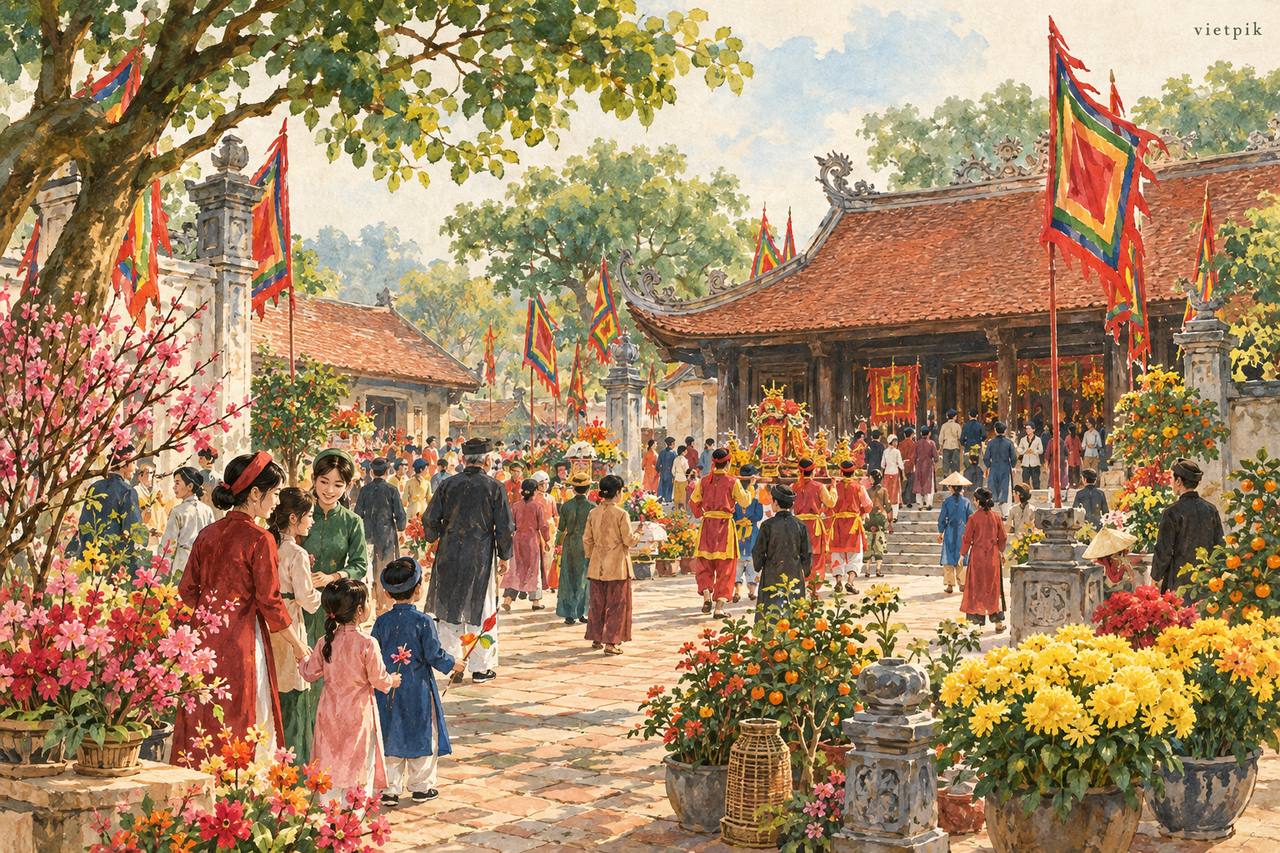
The courtyard, semicircular pond and sequence of temple, pagoda and communal house create several layers of attention. A visitor should avoid assuming that every movement belongs to the same rite. A pond can give an open view of the complex without explaining the function of each building. Before entering, orient yourself to the sign identifying the temple, then notice where the pagoda and communal house sit in relation to it. If a queue leads toward a particular sanctuary, do not assume it is a general visitor route. Reading the compound in this order makes the festival legible as several connected spaces and reduces unnecessary movement through people preparing offerings.
Choosing the river or temple focus
Because the site sits in a dense inner-city district, arrival time, pedestrian access and temporary crowd controls matter more than a long sightseeing checklist. The programme should determine the route. A compact itinerary can centre on one public ceremony and a later look at the compound. Someone chiefly interested in the river connection should first establish whether that component is taking place and where viewing is permitted; someone interested in commemoration may be better served by the temple programme. Those are different visits to the same tradition. Allow a separate meeting point outside the ceremonial entrance so companions can regroup without occupying the doorway or interrupting an approaching delegation.
The Trưng Sisters in public memory
The Sisters are historical leaders as well as sacred figures in local worship. Photography should not flatten worshippers, women carrying offerings or ceremonial roles into costume alone. The prominence of the Trưng Sisters invites discussion of women's place in public memory. Start with how the two leaders are named and honoured here, rather than assuming every woman present has a ceremonial office. Some are participants, some relatives, some visitors. A portrait can preserve that difference if its caption records a verified role. With children, compare the historical uprising with the later act of remembrance: one is a past event, the other is something communities continue to shape.
Keeping Đồng Nhân distinct
A useful record of the visit names Đồng Nhân, the exact year and the part actually witnessed. That precision prevents later captions from drifting toward Mê Linh or Hát Môn. Đồng Nhân, Mê Linh and Hát Môn can be read together as distinct places of remembrance, but their programmes must stay separate. Shared dedication does not make a photograph transferable between them. When assembling a travel album, give this stop its own location and date, and distinguish a river procession from a temple offering. The result is a more useful memory of Hanoi: several communities relating to the same historical figures through their own spaces, inherited stories and responsibilities.