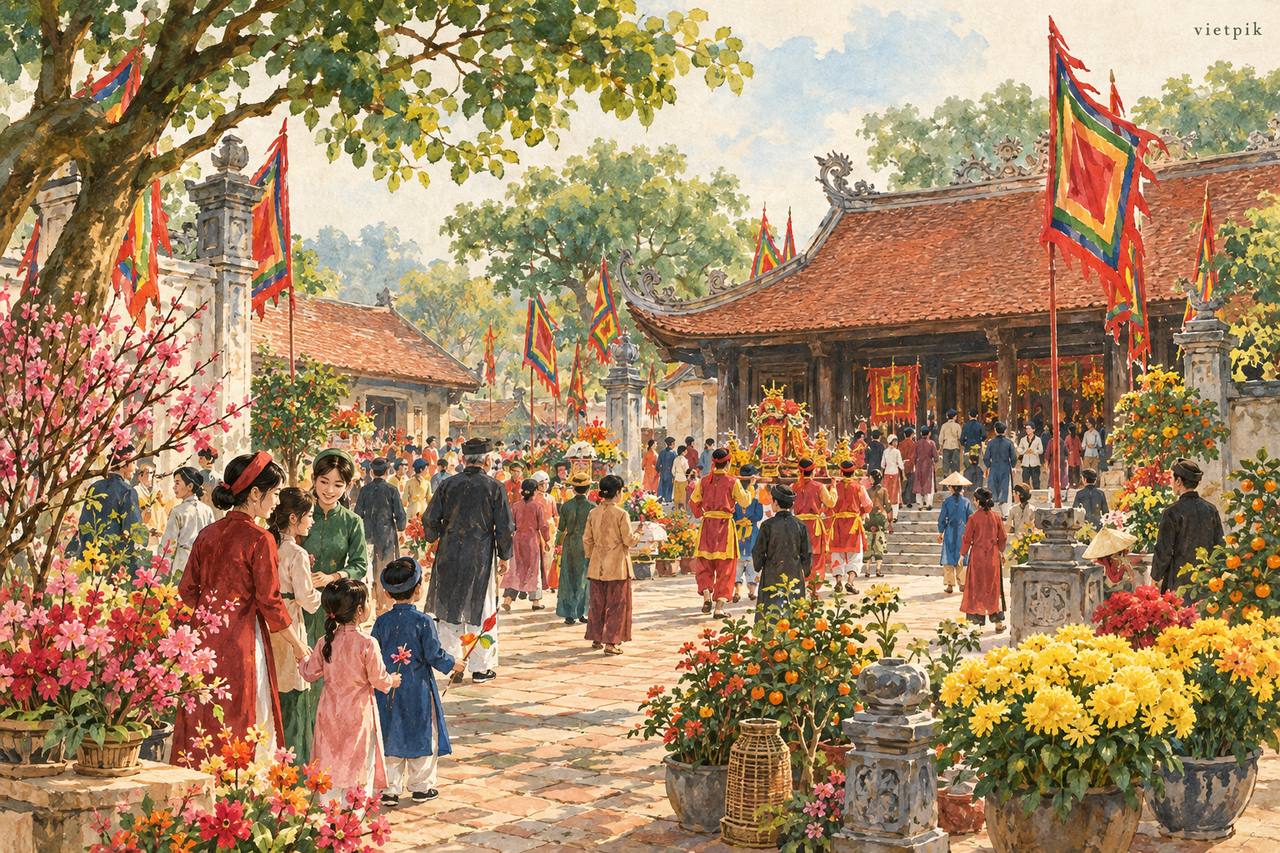
Khương Thượng Communal House preserves a village festival rhythm in a district now read mainly through modern streets. The contrast is useful, but it should not become nostalgia that erases the people doing present-day organising. A 2026 notice from the local authority identifies a two-day programme on lunar days eleven and twelve of the second month, with the twelfth as the principal day. Older descriptions do not all agree on the opening day, so this guide gives priority to the dated local notice for that edition and does not promote it into a confirmed 2027 schedule.
History & story
The communal house is associated with the local guardian tradition often named Quy Động in secondary descriptions. Architectural objects and inscriptions are evidence of long care, not a complete history by themselves. Khương Thượng should first be located through its own communal house and guardian tradition, not through a broad image of historic Hanoi. The name of today's Kim Liên ward can otherwise lead readers to confuse it with the separate temple festival dedicated to Cao Sơn. The 2026 local notice identifies the communal house at 165 Khương Thượng Street. Keeping that address with the festival name establishes a practical distinction before any discussion of old village boundaries or the surrounding urban landscape.
The distinct identity of Khương Thượng
The communal house is associated with the local guardian tradition often named Quy Động in secondary descriptions. Architectural objects and inscriptions are evidence of long care, not a complete history by themselves. Khương Thượng should first be located through its own communal house and guardian tradition, not through a broad image of historic Hanoi. The name of today's Kim Liên ward can otherwise lead readers to confuse it with the separate temple festival dedicated to Cao Sơn. The 2026 local notice identifies the communal house at 165 Khương Thượng Street. Keeping that address with the festival name establishes a practical distinction before any discussion of old village boundaries or the surrounding urban landscape.
Younger residents and present-day care
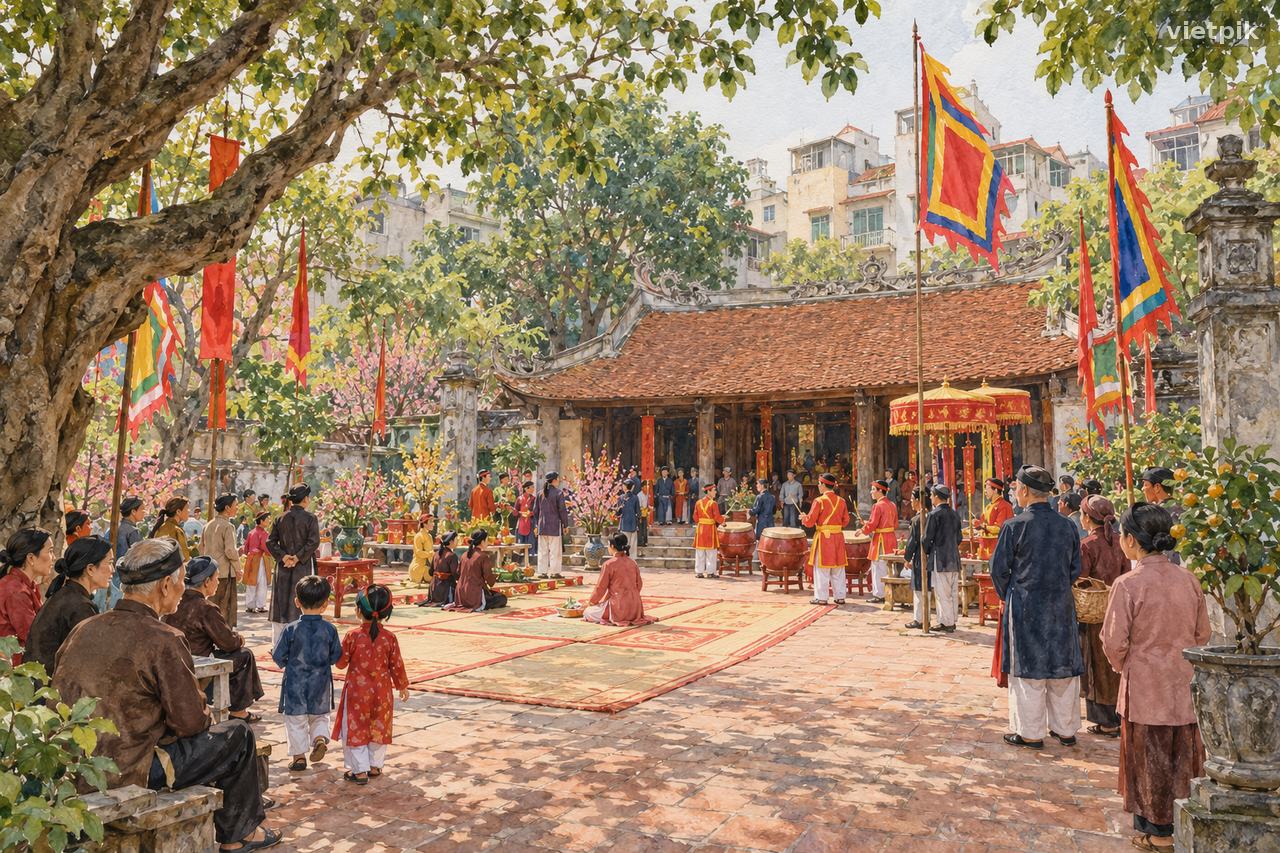
The official 2026 notice emphasised ceremonial observance together with community arts and responsible organisation. It framed safety, traffic and environmental order as part of festival quality. The emphasis on younger residents in the local notice offers a useful lens: a village festival inside a city depends on people choosing to take responsibility now. Decoration and public performances may catch the eye, but keeping access clear and helping visitors also shape the day. Observe those contributions without assuming every helper is a professional guide. The relationship between elders, organisers and younger participants is something to ask about locally, not a ready-made story of either decline or perfect continuity.
A precise 2026 notice, not a 2027 promise
For 2026, opening was announced for 29 March, lunar day eleven; lunar day twelve was principal. An older article citing day ten shows why undated repetition should be avoided. The published opening time for 2026 was 07:30 on 29 March, at the named communal house. This precise historical detail belongs only to that edition; it is not an opening-hours claim for the building or a reservation time for 2027. Different older accounts of the festival's lunar span should be retained as a source question. For a future trip, prefer the next dated local notice over a tourism summary that repeats a lunar date without naming its year or activity.
Lake, courtyard and waiting space
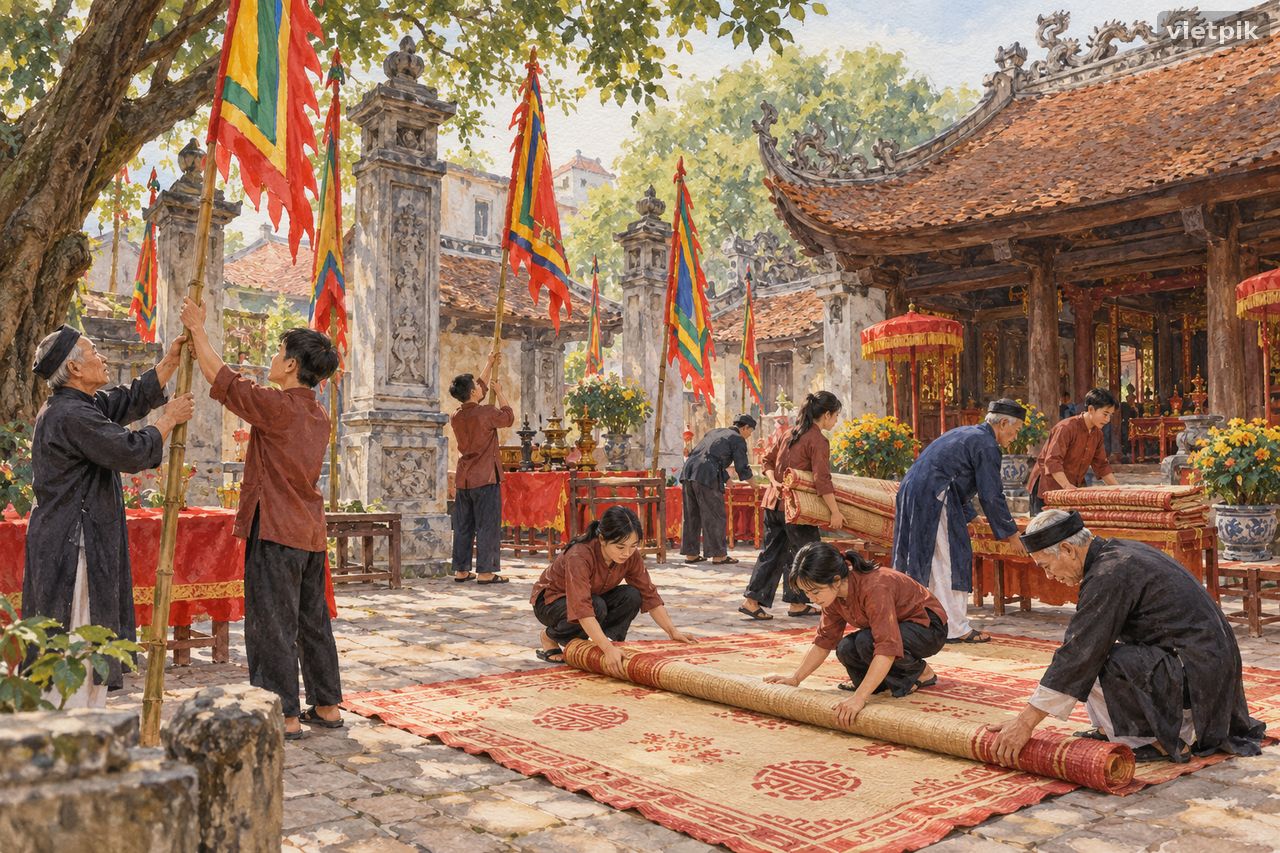
The small lake, greenery and courtyard form a visual pause inside the city. Observe how festival use rearranges familiar public space without assuming every decoration is ancient. The water and greenery create a different visual rhythm from the surrounding streets, but the useful observation is how the space is used. Is a path left for a delegation? Are spectators gathering by the water while a ritual team occupies the courtyard? Ask these as questions rather than expecting one fixed arrangement. Such attention makes an apparently quiet scene informative: the festival may be organising separation, waiting and passage even before the most visible activity begins.
Choosing one neighbourhood programme
Arrive on foot from a confirmed access point if possible, and do not rely on informal parking claims. Temporary local instructions are more reliable than travel-blog logistics. For a short neighbourhood visit, choose either the public opening or a separately announced performance as the anchor. Reports of music beside the communal-house lake do not establish a daily entertainment schedule. If you arrive between programme items, allow the place to be quiet instead of searching for someone to stage activity. A nearby street address is useful for orientation, but the final approach can change with local controls; confirm access before promising an effortless door-to-door stop to companions.
Old surfaces and the water edge
The communal house is not a studio set. Avoid leaning equipment on old surfaces, crossing ceremonial mats or turning family offerings into close-up content without permission. Older surfaces invite close looking, but they should not become supports for a tripod, a bag or a posed portrait. The water edge also deserves attention when people turn toward music or a procession and stop watching their footing. These are consequences of this particular setting, not reasons to avoid it. A considerate observer chooses a stable position with a clear path behind, leaving worship space for participants and room for residents who still need to move through their neighbourhood.
Village rhythm within the present city
A useful final note compares the annual village rhythm with the surrounding city only after naming the actual practices seen. “Old Hanoi” should be evidence, not a decorative cliché. Khương Thượng's interest lies in the relationship between a village's recurring act of remembrance and the present city around it. Neither side has to be erased for the other to feel authentic. A contemporary sound system or a young volunteer does not invalidate the old communal house; equally, an old roof does not prove every current performance is centuries old. Describe what belongs to the building, what belongs to the announced edition and what people explain as inherited practice, keeping each claim at its proper scale.