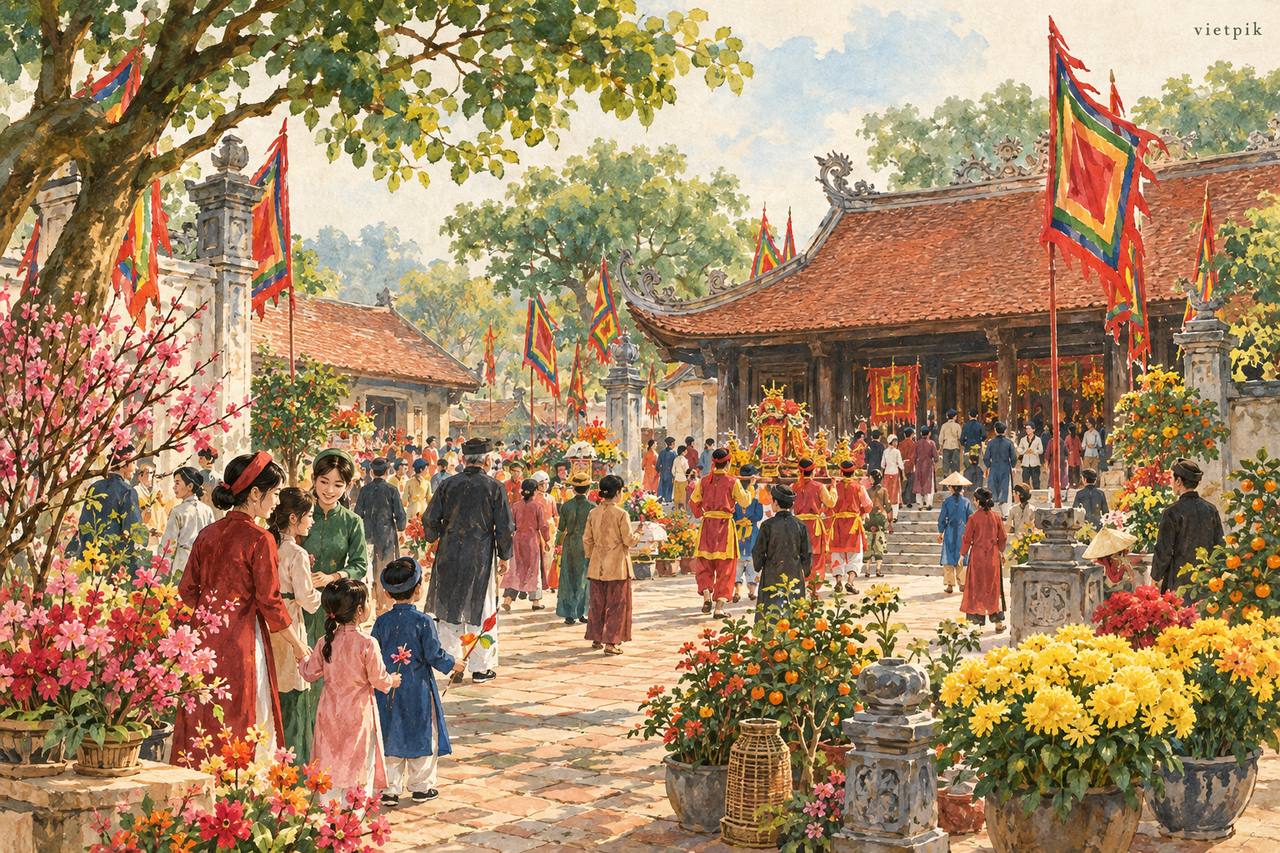
Kim Liên is often introduced in one line as the southern guardian of old Thăng Long. A festival article needs to do more than repeat that label. The useful work is to connect the veneration of Cao Sơn Đại Vương with the đình–đền setting, the annual lunar milestone and the way a historic village identity remains legible inside central Hanoi. Sources use both communal-house and temple language, so this guide retains the paired description instead of forcing a false single-building certainty. It also distinguishes the Kim Liên festival from the nearby Khương Thượng celebration, which has its own site and calendar.
History & story
The southern-guardian identity belongs to a larger four-temple frame, yet Kim Liên has its own local cult, objects and village history. Begin with the site before expanding to the city-wide map. Cao Sơn Đại Vương is the focus of devotion here. The guardian label gives the temple a place in the story of Thăng Long, while the communal-house identity points toward a smaller community gathering around it. Holding both scales in mind makes the visit more interesting: the capital's symbolic southern boundary and a neighbourhood's shared place are not competing explanations. They show how a local shrine can carry a city-wide meaning without losing the people who care for it.
Cao Sơn and the southern guardian
The southern-guardian identity belongs to a larger four-temple frame, yet Kim Liên has its own local cult, objects and village history. Begin with the site before expanding to the city-wide map. Cao Sơn Đại Vương is the focus of devotion here. The guardian label gives the temple a place in the story of Thăng Long, while the communal-house identity points toward a smaller community gathering around it. Holding both scales in mind makes the visit more interesting: the capital's symbolic southern boundary and a neighbourhood's shared place are not competing explanations. They show how a local shrine can carry a city-wide meaning without losing the people who care for it.
Offerings and the work of preparation
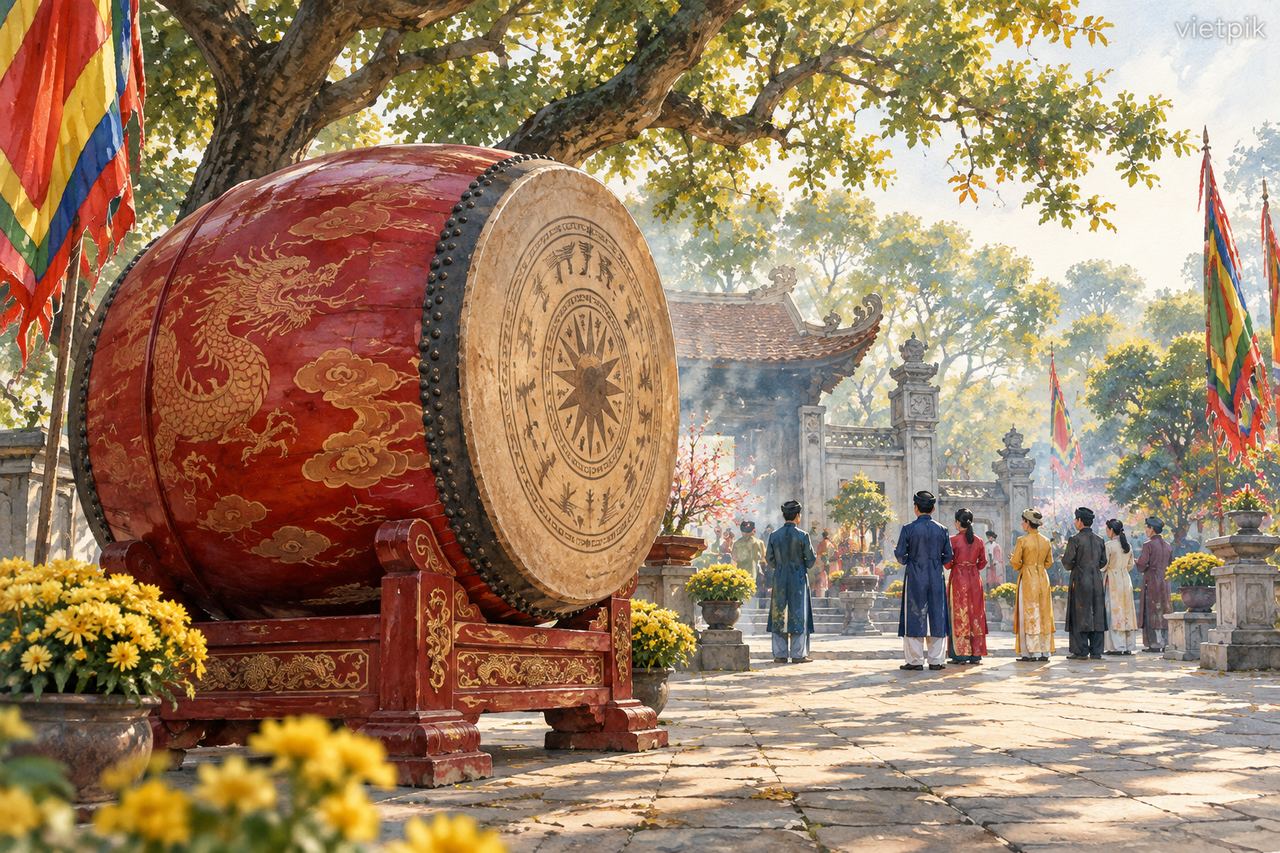
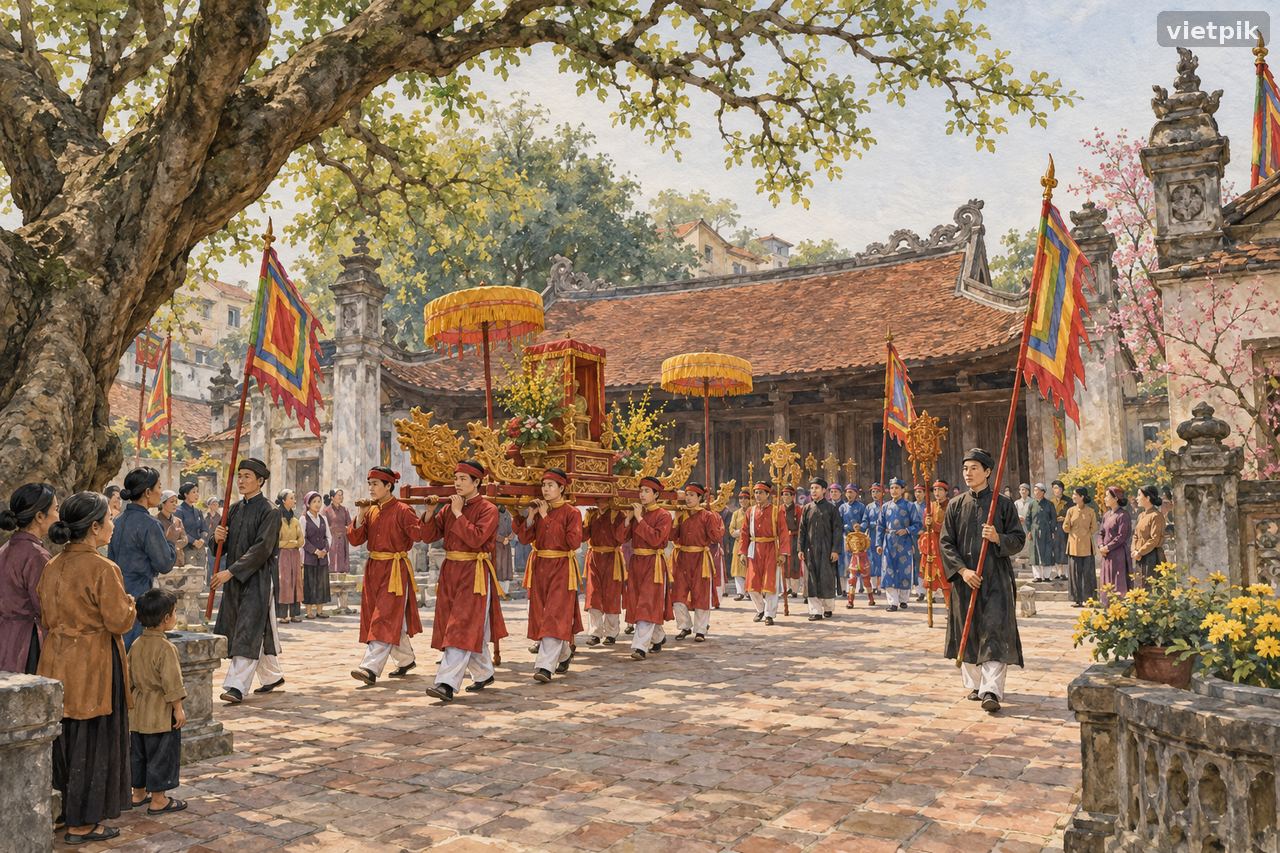
Modern accounts describe processional and ceremonial components around the communal-house and temple complex. The interest lies in how a former village centre still gathers participants within a transformed urban district. Coverage of the 2026 programme describes ritual teams alongside drums, flags and a restored seven-tier offering arrangement. Treat the restored arrangement as a feature of that announced edition, not a claim that every future celebration will reproduce it. For observation, separate the making of an offering from its presentation: one reveals practical organisation, the other its ceremonial position. If the preparation area is closed, an explanation by a custodian is more appropriate than trying to enter for a closer view.
The main day within the 2026 programme
Sources commonly place the festival on lunar days fifteen and sixteen of the third month, with the sixteenth as the principal day. No official Gregorian programme for 2027 was available at review. The programme reported for 2026 extended from 30 April to 2 May, corresponding to lunar days fourteen through sixteen. That wider span does not erase descriptions of a shorter traditional observance: the principal day remains the shared reference, while the public programme can expand around it. The 2027 dates remain unconfirmed here. A visitor interested specifically in the procession should look for that item by name, rather than assume it takes place throughout every advertised festival day.
Watching the passage into the courtyard
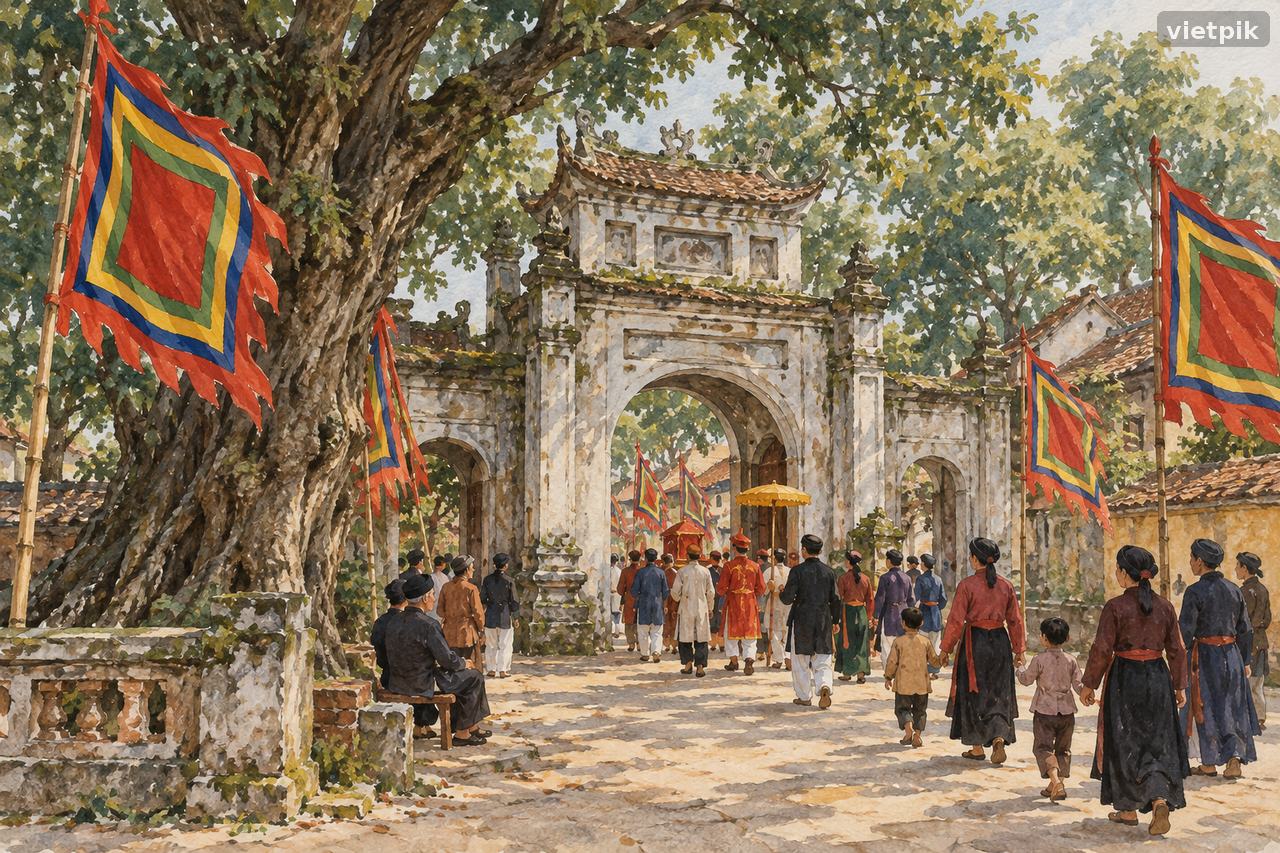
Look for thresholds: gate, courtyard, altar axis and the line between public viewing space and the working area of ritual teams. These boundaries explain how the event is organised. A procession changes the meaning of an entrance. What looks like a convenient passage during a quiet visit may become an axis reserved for the ritual team. Before settling into a viewing place, check whether it faces an approaching movement or occupies its turning space. Looking along an edge rather than straight at the altar can make the order of arrival clearer. It also leaves the central relationship between the team, offerings and sanctuary visible to the people taking part.
Finding the right Kim Liên
Combine the visit with a small surrounding walk only after checking the confirmed ceremony time. Heavy urban traffic can make a short map distance slower than expected. Be careful with the name Kim Liên in navigation. The festival concerns the temple associated with Cao Sơn, while administrative names and other local landmarks may also use Kim Liên. Contemporary 2026 coverage gives the temple at 148 Kim Hoa and identifies its then-current ward as Văn Miếu–Quốc Tử Giám. Save the full place name and street together; do not search only for a ward name. The separate Khương Thượng festival should remain a different stop with its own date.
Objects, uses and historical evidence
Do not label every yellow or red object as royal symbolism. If an emblem is not explained by a sign or interpreter, describe its colour and position rather than inventing a meaning. An old inscription, a recently prepared offering and a performance costume belong to different kinds of evidence. A carved text may help establish the shrine's history, while a costume shows what a team wore for a particular occasion. Neither automatically explains the other. When a detail catches your eye, ask what it is used for before asking how old it is. This order often produces a more grounded conversation than starting with assumptions about royalty, antiquity or a supposedly fixed symbolic code.
One local story within the Four Guardians
A strong caption names Cao Sơn Đại Vương, Kim Liên and the year only when these are actually relevant to the image. It should not claim to depict all Four Guardians at once. For a concise travel story, pair the larger guardian tradition with one verified local detail: a named ceremonial team, an explained offering, or the passage from street to courtyard. This prevents the Four Guardians label from swallowing the distinctiveness of Kim Liên. If discussing a revived practice, name the edition and the reporting that describes it. Revival is an act of present-day cultural care; it does not require claiming that every gesture has survived unchanged or that visitors have witnessed an entire historical court ritual.