The Sái Temple festival is widely recognised for its “living king” procession, in which local participants embody a royal court for the ceremonial journey. The practice grows from narratives linking the site, An Dương Vương, the Cổ Loa world and Huyền Thiên Trấn Vũ. Those narratives give the rite its symbolic logic, but they should not be treated as a literal reconstruction of an ancient royal visit. This guide keeps attention on community selection, preparation and procession space. It uses lunar 11/1 as the traditional milestone and leaves every Gregorian detail for 2027 unresolved.
History & story
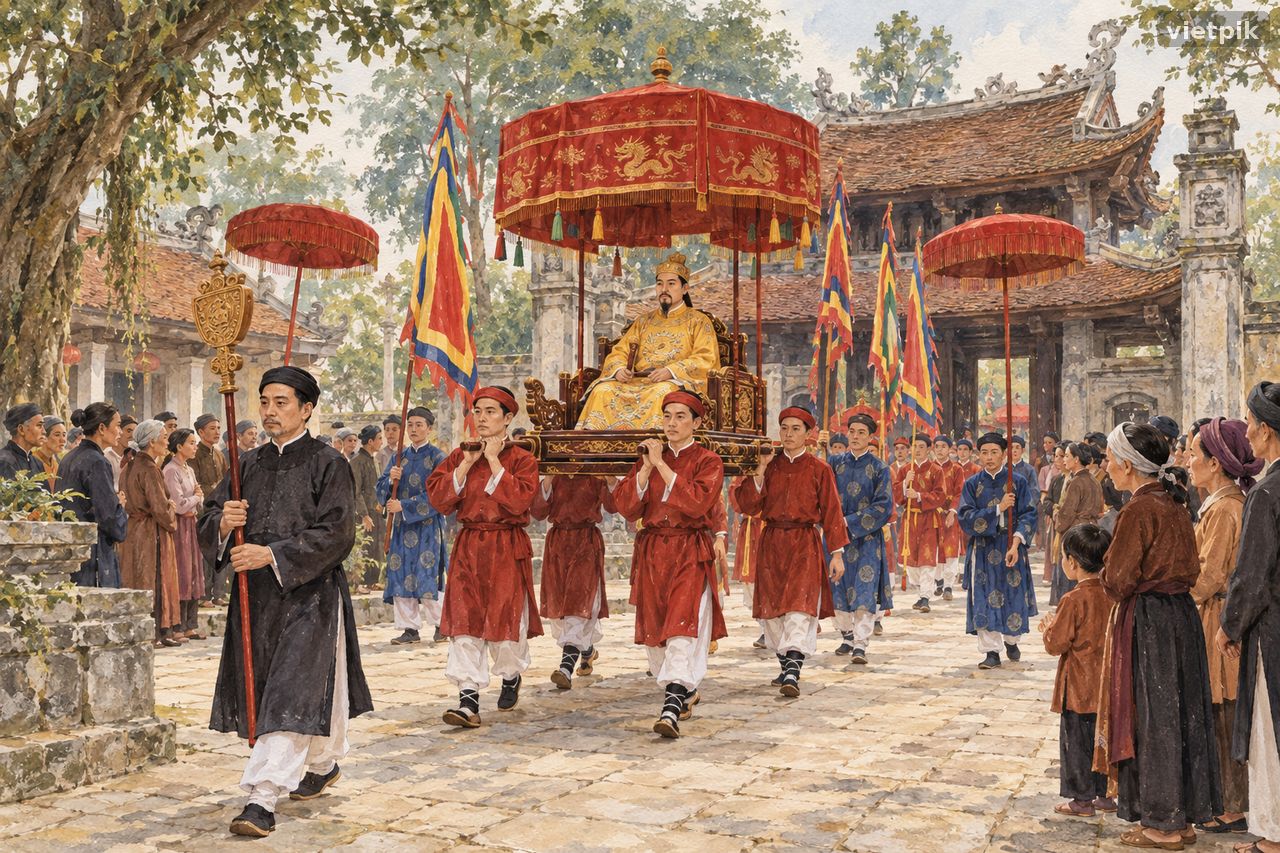
The festival’s “king,” “lord” and mandarins are community roles for a defined ritual occasion. The point is not impersonation for entertainment but responsibility within a locally governed ceremony. The phrase living king can sound sensational when detached from its setting. Here it refers to a person entrusted with a role, not a claim that a monarchy continues to govern the village. Local reporting describes elders receiving that trust, which makes the selection a matter of community recognition. Understanding this changes what is worth looking at: not merely a richly dressed central figure, but the relationships of responsibility surrounding someone who is ordinarily part of village life.
The living king as a community role
The festival’s “king,” “lord” and mandarins are community roles for a defined ritual occasion. The point is not impersonation for entertainment but responsibility within a locally governed ceremony. The phrase living king can sound sensational when detached from its setting. Here it refers to a person entrusted with a role, not a claim that a monarchy continues to govern the village. Local reporting describes elders receiving that trust, which makes the selection a matter of community recognition. Understanding this changes what is worth looking at: not merely a richly dressed central figure, but the relationships of responsibility surrounding someone who is ordinarily part of village life.
The work supporting ceremonial honour
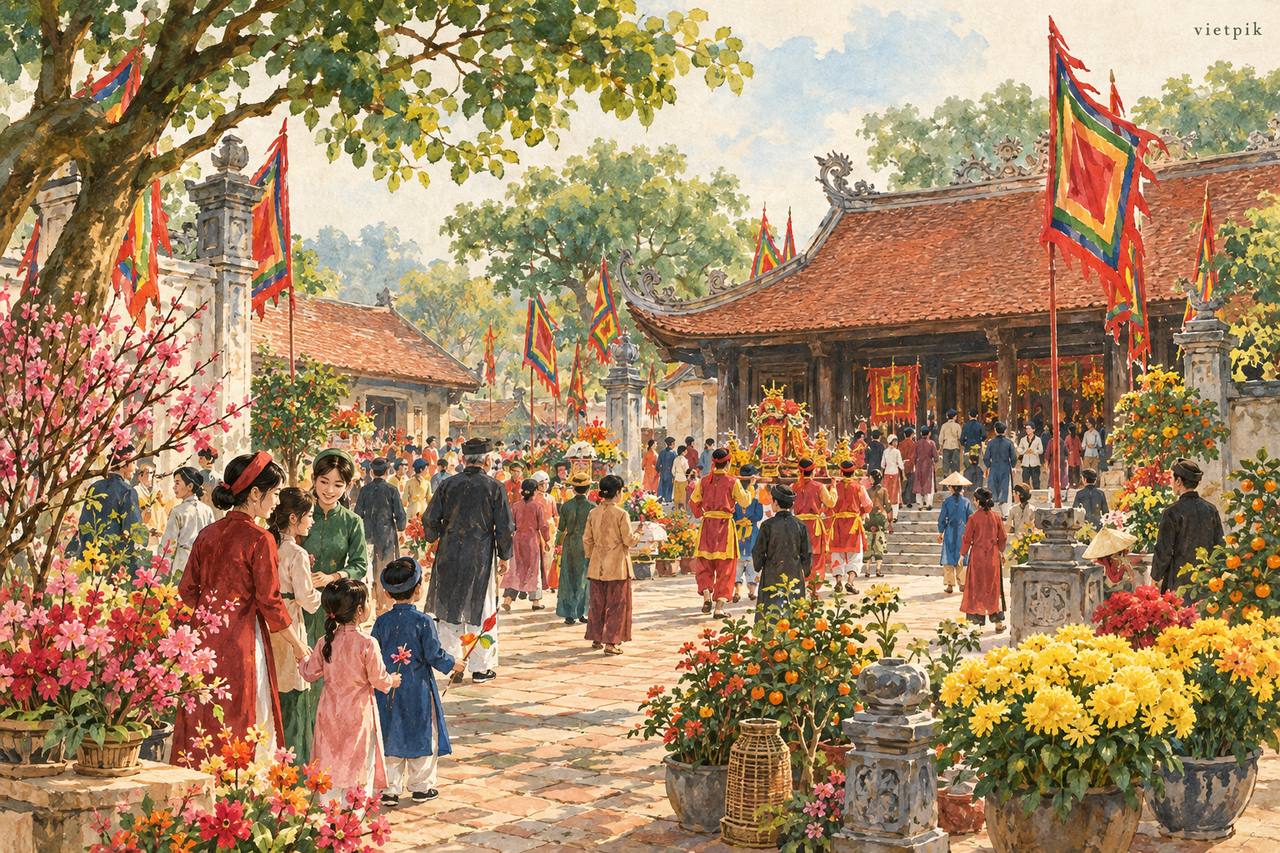
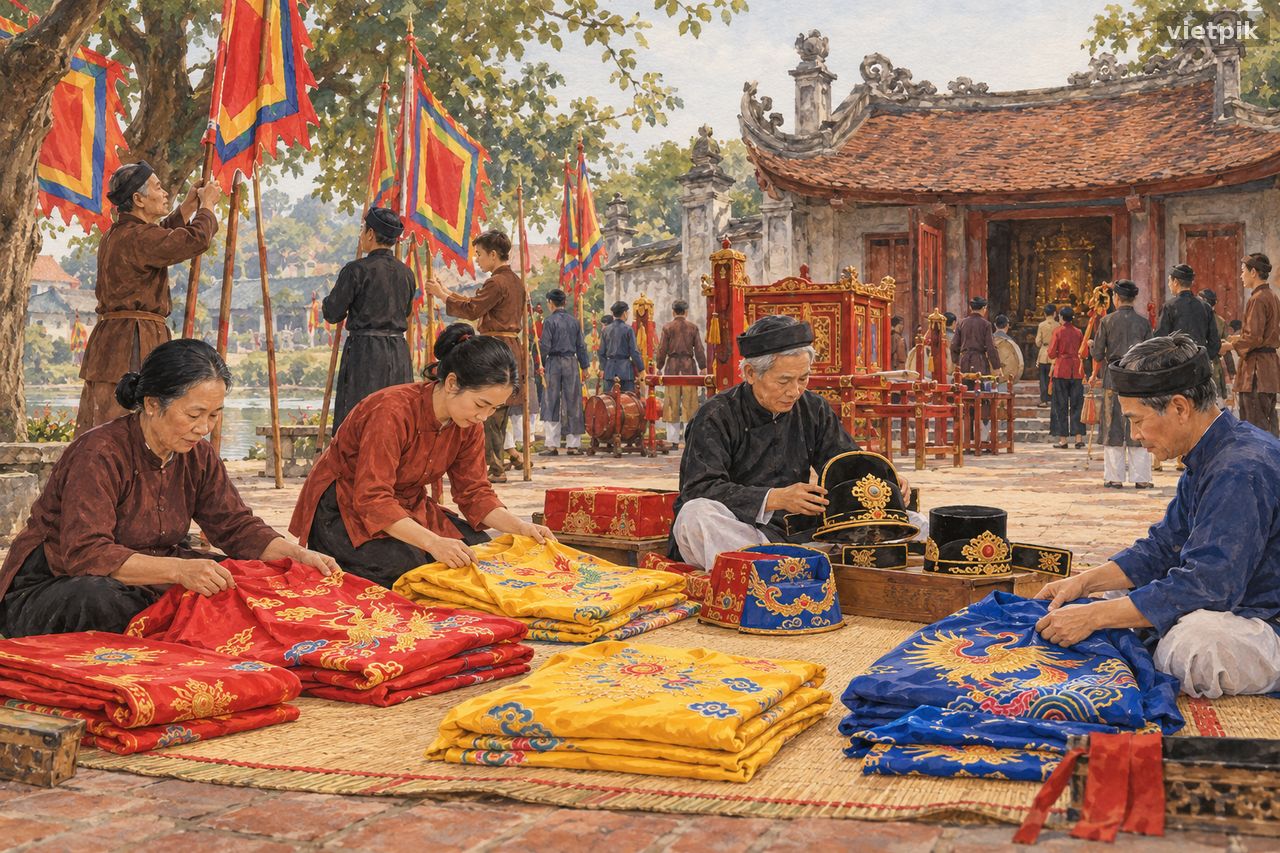
Preparations described by heritage sources begin before the main day, including making ceremonial spaces and offerings. The procession therefore rests on work that spectators may never see. A ceremonial role depends on support: clothing must be prepared, people know where to gather, and movements have to fit a route. The photographs of preparation included here are conceptual illustrations of that work, not evidence for the exact dress of a named elder. For visitors, preparation can raise good questions about who assists and how duties are learned. Some tasks may be private or restricted; their importance does not depend on making them visible to every camera.
Morning rites and afternoon procession
The eleventh day of the first lunar month is the stable public reference. Reports from 2025–2026 document recent editions and heritage recognition, not an official 2027 timetable. The Thư Lâm account places the 2026 procession on 27 February, corresponding to the eleventh lunar day. Its description distinguishes morning ritual activity from the afternoon procession. This is a useful warning against equating the festival date with one continuous parade. A future programme may organise those parts differently. Anyone hoping to see the central procession should confirm its own start, route and viewing arrangements, rather than arrive at a time copied from a past year's ceremonial notice.
Seeing the procession as an ensemble
Processional dignity depends on clear routes and measured pace. A respectful observer watches how escorts, music and spacing support the principal roles rather than rushing toward the central figure. Consider the procession as an ensemble. Escorts create a moving boundary, music shapes attention, and the central participants depend on others to keep the route workable. A photograph that crops away everyone except the principal figure can lose that cooperation. From a safe edge, include enough of the surrounding group to show the relationship. Resist stepping backward into the path while framing a shot; the wish for a symmetrical portrait should not force the procession to adjust around a spectator.
Thụy Lôi and Thư Lâm
Thụy Lôi and current Thư Lâm labels can both appear in sources because administrative names changed. Save both in notes so place history is not mistaken for two festivals. The older village name is useful for understanding local memory, while the current commune label helps find contemporary announcements. These serve different purposes and can be recorded together. Before travelling, compare the named temple and village with the notice rather than trusting a broad map result for Thư Lâm. The connection to Cổ Loa in the sacred narrative also does not make the two festivals the same destination. Keep this visit anchored to Đền Sái and its locally organised procession.
Portraits without interrupting the role
Do not address a participant casually by a ceremonial title outside context or request a staged royal pose. Ask organisers when portrait photography is acceptable. An elder in ceremonial dress remains a person with preferences and limits. If portraits are allowed, a moment before or after the formal movement may be more suitable than interrupting the role in action. Ask through an organiser when uncertain. Avoid treating the words king and lord as jokes aimed at the participant; the community's ceremony has its own register. A respectful caption can explain the temporary role clearly without either mocking it or suggesting the person holds an actual government office.
Legend expressed through village action
The strongest interpretation explains why a community rehearses hierarchy temporarily, then returns to ordinary life. It avoids claiming that clothing or court order is archaeologically exact. The An Dương Vương and Huyền Thiên Trấn Vũ narratives provide a sacred explanation of place, while the contemporary festival shows how that explanation is expressed through communal action. Keep those layers visible. A reader can appreciate the symbolic link without taking every supernatural episode as a historical event. The resulting story is stronger than a claim about the strangest ritual in Hanoi: it shows neighbours assigning honour, organising movement and making inherited memory publicly meaningful for a defined occasion.