Thị Cấm turns the work behind a pot of rice into a sequence that a whole village can recognise: running for water, making fire, processing grain and managing heat under pressure. The attraction is not culinary novelty alone. It is coordination, learned technique and the public evaluation of a staple food whose preparation normally disappears inside a household kitchen. The festival was entered on Vietnam’s national intangible-heritage list in 2021. This guide uses that status and reporting from recent editions to explain the sequence without claiming that every team, prop or judging detail will be identical in 2027.
History & story
The festival honours Phan Tây Nhạc and Hoa Dung in local tradition. The military-provision story should be identified as transmitted narrative rather than used as proof of a precisely dated ancient event. The provisioning story gives an everyday meal a public meaning: feeding a group requires organisation as well as strength. That is a useful starting point for someone unfamiliar with a rice-cooking festival. The contest is not a restaurant demonstration or an invitation to compare dishes from different regions. Its interest lies in how basic materials become a result through distributed work. Ask how the village explains that connection today, rather than treating a legendary military setting as a precisely reconstructed ancient competition.
A meal in the village memory
The festival honours Phan Tây Nhạc and Hoa Dung in local tradition. The military-provision story should be identified as transmitted narrative rather than used as proof of a precisely dated ancient event. The provisioning story gives an everyday meal a public meaning: feeding a group requires organisation as well as strength. That is a useful starting point for someone unfamiliar with a rice-cooking festival. The contest is not a restaurant demonstration or an invitation to compare dishes from different regions. Its interest lies in how basic materials become a result through distributed work. Ask how the village explains that connection today, rather than treating a legendary military setting as a precisely reconstructed ancient competition.
Fire, water and grain as linked tasks
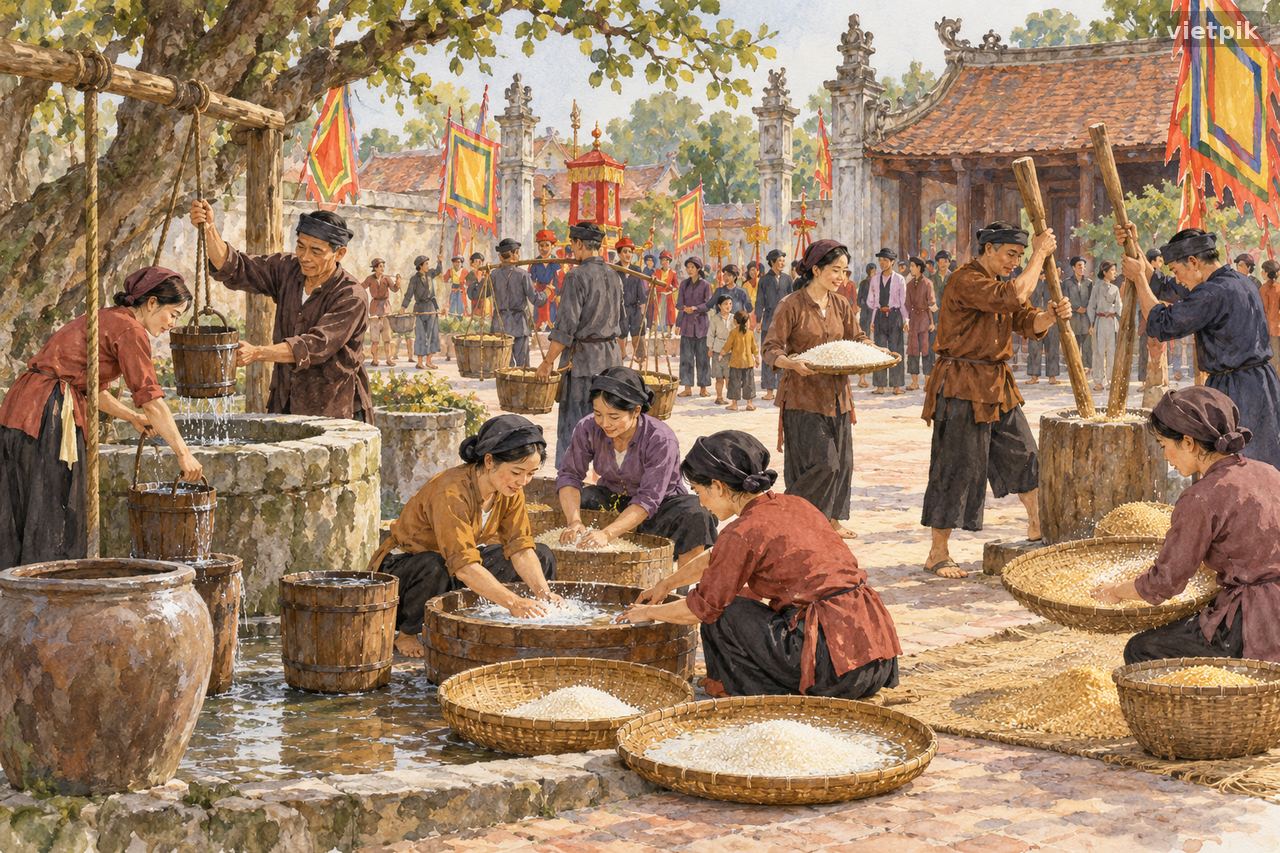
Accounts consistently describe linked tasks: obtaining water, creating fire, pounding or preparing rice and cooking. Success depends on teams distributing attention, not one theatrical gesture. Follow one team's dependencies. Water arriving early is useful only if grain preparation and the fire also progress; an impressive flame alone cannot finish the rice. Seen this way, the competition becomes a sequence of handovers rather than unrelated feats. The official tourism description separates fire-making, running, pounding and cooking, while current reporting sometimes groups these into broader stages. Those descriptions can coexist: they count the tasks differently without necessarily describing different festivals or incompatible rules.
The eighth lunar day and the 2026 edition
The eighth day of the first lunar month is the traditional reference. Recent journalism confirms the practice continued in 2026, but a dated official programme for 2027 was not available. The 2026 contest was reported on 24 February, the eighth lunar day, in wet conditions. That dated report confirms an edition, not the weather visitors should expect in another year. It also illustrates why a timetable cannot predict the exact moment a team gets fire or finishes cooking. For a future visit, allow room for the contest's own pace. The published start and the moment of judging are different milestones, and neither should be invented from a typical festival duration.
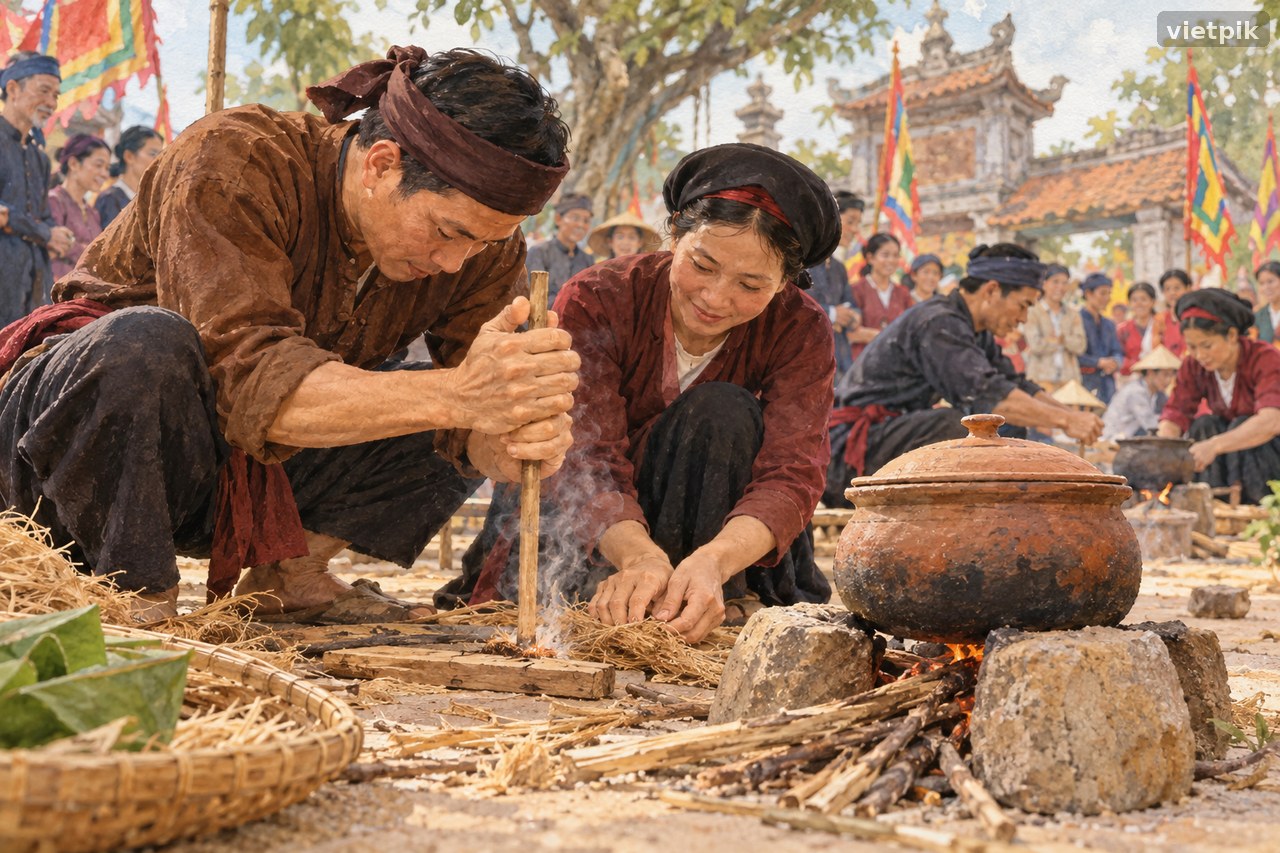
Following hands and handovers
Watch the hands and handovers. A spark, a pestle rhythm or a covered pot explains labour and timing more directly than smoke filling the whole frame. A good sequence of photographs could move from the unworked materials to coordinated effort and finally to the covered pot. This gives viewers a way to understand what changed without relying on a dramatic smoke cloud. From an observation point, notice where people look when a task is delayed: attention often reveals a dependency before the next handover happens. Do not ask a participant to repeat an action for the camera; repetition can affect both the competition and the team's concentration.
Running lanes and working circles
Stand clear of running lanes and working circles. The safest viewpoint may be slightly farther away, where the whole sequence remains visible without obstructing participants. The running and fire-making spaces call for different distances. A runner needs a clear line ahead, while people working around embers need a stable perimeter. Do not drift between those zones while looking at a screen. Children can follow the sequence from a single agreed position, with an adult explaining which task feeds the next. If smoke moves toward that position, leave by the outside edge rather than cutting through a team's working circle in search of cleaner air.
The finished pot belongs to the judges
Do not touch grain, tools or pots, and do not interpret smoke as disorder. Ask organisers how judging works in that edition rather than repeating a schoolbook version as a fixed rule. The assessment belongs to the judges, and the cooking vessels are competition equipment until the event is finished. A pot being opened is not permission to lean over it, sample rice or offer commentary to the team. For an informative question afterward, ask how cooks recognise readiness under the rules used that day. That invites explanation of skill without claiming a secret recipe or turning ceremonial food into a product that every visitor can expect to buy or taste.
Telling the story through coordination
A good story follows transformation: dry material becomes fire, paddy becomes rice, separate roles become one result. Name the version observed and leave unverified folklore clearly labelled. Thị Cấm is particularly rewarding when described through coordination under constraint. The story can remain vivid without naming a winner you did not verify or adding a dramatic mishap you never witnessed. Keep the early first-month rice contest separate from later local friendship processions, even when sources mention the same village. A reader should leave knowing why fire, water and grain are linked here, and what they must confirm before travelling to see that cooperation unfold for themselves.